Reptiles and Amphibians
Louisiana Pinesnake
Pituophis ruthveni
One of the rarest snakes in North America, dependent on longleaf pine savanna and the pocket gophers that dig its shelter.
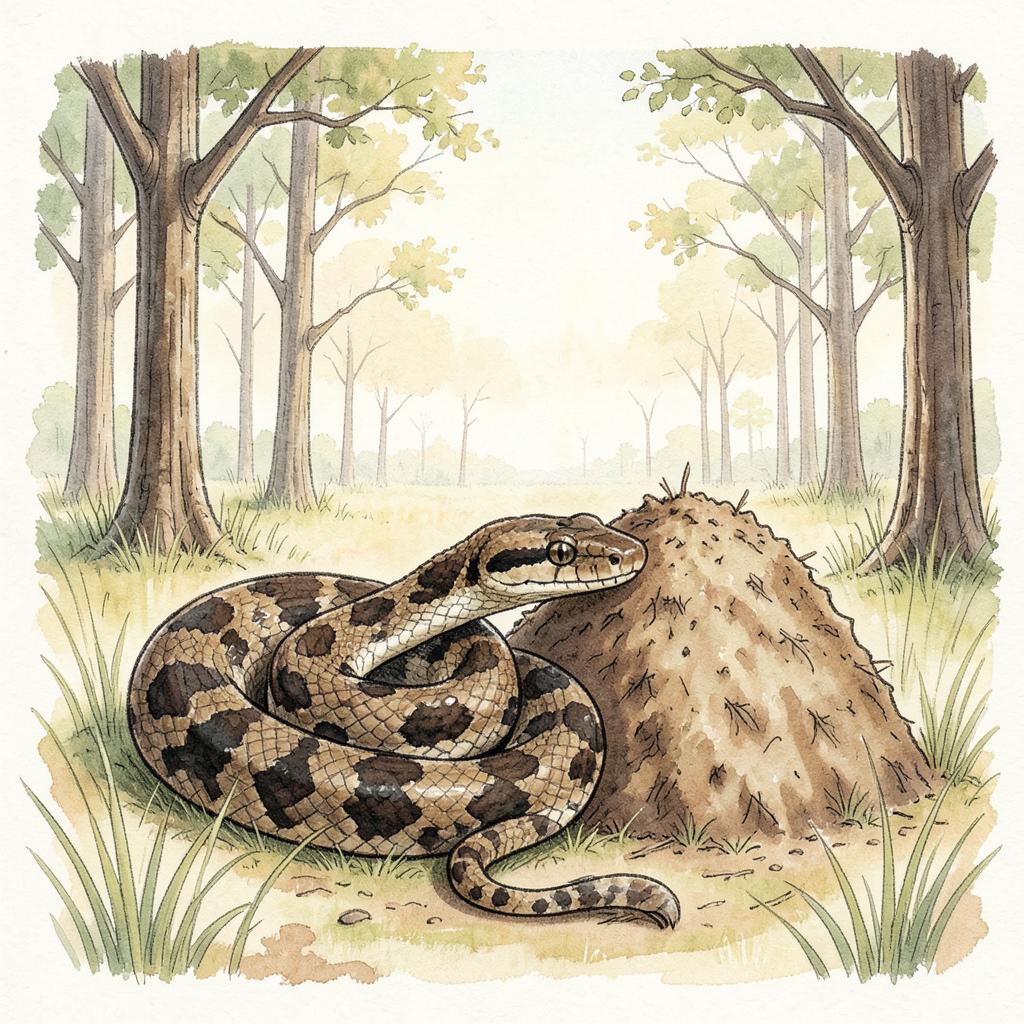
Illustrated Species Ambassador
Ruthven — Louisiana Pinesnake
I'm Ruthven, an illustrated ambassador for the Louisiana pinesnake. I am large, I am not venomous, and most of my life happens underground.
- One fact worth knowing
- The Louisiana pinesnake is one of the rarest snakes in North America and depends closely on Baird's pocket gopher — for prey and for the burrow systems it lives in.
- What I depend on
- I depend on open longleaf pine savanna with a grassy, herb-rich understory that supports pocket gophers, kept open by regular fire.
- My greatest threat
- My greatest threat is the loss of open, fire-maintained longleaf pine savanna.
- One way you can help
- Never kill a snake you cannot identify, and support longleaf pine restoration and prescribed fire on public and private land in Louisiana and east Texas.
This ambassador is an original illustration created for this project. It is an educational character, not a documentary image, and its statements follow the sourced record on this page. Artwork and rights record
Why this species matters
The pinesnake depends on a rodent that depends on a grass layer that depends on fire. It shows how a species can be lost not by direct persecution but by the quiet removal of two links beneath it.
If it disappears: Its extinction would signal that fire-maintained longleaf savanna no longer functions across the western Gulf coastal plain.
Conservation status
- IUCN Red List
- EndangeredLast verified 2026-09-08
- U.S. Endangered Species Act
- ThreatenedListed in 2018 with a 4(d) rule.Last verified 2026-09-08
- Texas
- Threatened (state listed)Last verified 2026-09-08
- Louisiana
- State species of conservation concernLast verified 2026-09-08
Population
Extremely rare. Trapping surveys across the range have historically produced very low capture rates, and the species is known from a small number of scattered sites in Louisiana and east Texas.
Trend: Decreasing
As reported: USFWS species status assessment and listing rule, 2018
Source: U.S. Fish and Wildlife Service
Uncertainty: No population estimate is published. Detection rates are so low that abundance cannot be reliably inferred.
Fragmentation: Known occurrences are separated and mostly small.
Range and distribution
Historic range: Longleaf pine savanna across west-central Louisiana and east Texas.
Current range: A small number of sites, largely on national forest and military land.
Range contraction: Absent from most historic localities.
Regions occupied
- West-central Louisiana
- East Texas
Habitat
Primary habitat: Open longleaf pine savanna on sandy, well-drained soils with a dense herbaceous ground layer.
Breeding habitat: Lays eggs underground, often in gopher burrow systems.
Feeding habitat: Hunts Baird's pocket gophers in their own tunnels.
Critical habitat: No critical habitat designated.
Habitat dependencies
- Baird's pocket gopher populations, which supply both prey and burrows
- Frequent fire to maintain an open, grassy understory
Biology and ecology
A specialized predator of pocket gophers and an indicator of intact, fire-maintained longleaf savanna.
Important adaptations: Hisses loudly and vibrates its tail when threatened, which causes it to be mistaken for a rattlesnake and killed.
- Size
- About 48–56 inches long, occasionally longer.
- Weight
- Varies with length; a large adult is a heavy-bodied snake.
- Lifespan
- Estimated 10–20 years.
- Diet
- Predominantly Baird's pocket gophers, with other small mammals taken occasionally.
- Reproduction
- Lays the largest eggs of any North American snake, producing very large hatchlings.
- Offspring
- A very small clutch — often only 3–5 eggs.
- Breeding frequency
- Once a year at most.
- Age at maturity
- About 3 years.
Primary threats
Habitat loss
Conversion of longleaf pine savanna to dense pine plantation and agriculture.
Fire suppression
Without frequent fire, the herbaceous layer disappears and pocket gophers decline.
Loss of prey
Baird's pocket gopher numbers have fallen with habitat change, removing the snake's main food and shelter.
Road mortality
A large, slow-moving snake is frequently killed on roads.
Persecution
Mistaken for a venomous snake and killed on sight.
Very low reproduction
A clutch of three to five eggs gives almost no buffer against losses.
Conservation and recovery
Programs and efforts
- USFWS recovery planning following the 2018 threatened listing
- Captive breeding and reintroduction led by the Memphis Zoo and partner institutions
- Longleaf pine restoration and prescribed burning on Kisatchie National Forest
- Reintroduction to restored sites in Louisiana
Protected areas
- Kisatchie National Forest, Louisiana
- Fort Johnson (formerly Fort Polk)
- Texas state and private restoration sites
Legal protections
- Endangered Species Act (threatened, with a 4(d) rule)
- Texas state threatened listing
Measurable progress
- Captive-bred snakes have been released into restored longleaf habitat since the 2010s
Continuing challenges
- Very low detection makes monitoring hard
- Prey recovery must precede snake recovery
- Small clutch size limits growth
How people can help
What individuals can do
- Never kill a snake you cannot identify — this one is harmless and federally protected
- Slow down on rural roads through pine country
- Leave pocket gopher mounds undisturbed
What communities can do
- Support prescribed burning and longleaf restoration on public land
Educational actions
- Teach snake identification to reduce killing of non-venomous species
Habitat support
- Restore longleaf pine with an open grassy understory rather than dense plantation
Organizations and programs to learn about
- USFWS Louisiana Ecological Services
- Memphis Zoo
- The Longleaf Alliance
Educational notes
- A three-link dependency — fire, grass, gopher, snake — that makes ecosystem thinking concrete.
- Lays the largest eggs of any North American snake.