Birds
Kirtland's Warbler
Setophaga kirtlandii
A jack pine specialist delisted in 2019 after recovery, still dependent on managed young forest and continuous cowbird control.
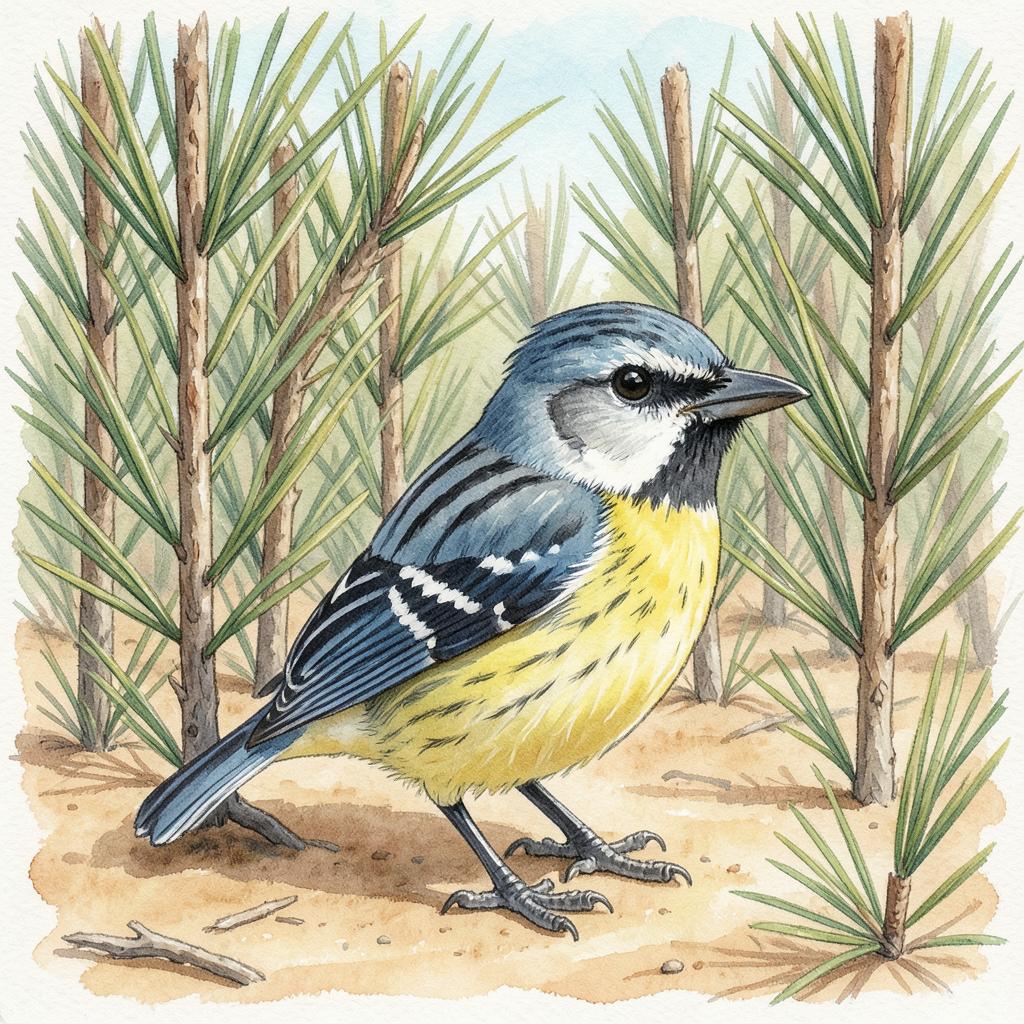
Illustrated Species Ambassador
Jack — Kirtland's Warbler
I'm Jack, an illustrated ambassador for Kirtland's warbler. I nest on the ground beneath jack pines, but only while those pines are still young and dense.
- One fact worth knowing
- Kirtland's warbler nests almost entirely in young jack pine stands of a particular age and density, and its recovery depends on continuous forest management creating new stands.
- What I depend on
- I depend on large stands of young jack pine on sandy soil, and on cowbird numbers being kept in check where I nest.
- My greatest threat
- My greatest threat is the loss of young jack pine habitat, which must be actively and permanently maintained.
- One way you can help
- Support the jack pine management and cowbird control programs in Michigan, Wisconsin and Ontario — this is a species that stays recovered only while that work continues.
This ambassador is an original illustration created for this project. It is an educational character, not a documentary image, and its statements follow the sourced record on this page. Artwork and rights record
Why this species matters
Kirtland's warbler is the clearest example of a species that cannot exist without human management now that wildfire has been suppressed. It also shows recovery is not the end of the work — the birds still need managed habitat every year.
If it disappears: Its decline would mean jack pine barrens management had lapsed, and would call into question whether conservation-reliant species can be safely delisted.
Conservation status
- IUCN Red List
- Near ThreatenedLast verified 2026-09-08
- U.S. Endangered Species Act
- Delisted due to recovery in 2019Recovery depends on ongoing habitat management and cowbird control formalized in a post-delisting plan.Last verified 2026-09-08
- Canada (SARA)
- EndangeredLast verified 2026-09-08
Population
Roughly 2,300–2,500 singing males, corresponding to an estimated 4,500–5,000 birds.
Trend: Stable
As reported: Annual census reporting by Michigan DNR and USFWS partners, 2020s
Source: U.S. Fish and Wildlife Service; Michigan Department of Natural Resources
Uncertainty: Counts are of singing males, a standard survey unit; total population is inferred from that count.
Historical: Fell to about 167 singing males in 1987, its recorded low.
Range and distribution
Historic range: Jack pine barrens of northern Michigan, with occasional records elsewhere in the Great Lakes.
Current range: Northern Lower and Upper Michigan, with small numbers in Wisconsin and Ontario.
Migration: Winters almost entirely in the Bahamas archipelago.
Regions occupied
- Michigan
- Wisconsin
- Ontario, Canada
- The Bahamas (wintering)
Habitat
Primary habitat: Dense young jack pine stands roughly 5 to 20 years old on sandy soil.
Breeding habitat: Nests on the ground beneath the living lower branches of young jack pines.
Feeding habitat: Insects and, in winter, fruit from Bahamian scrub.
Seasonal differences: Winters in low broadleaf coppice scrub in the Bahamas.
Habitat dependencies
- Jack pine stands of a specific narrow age class, historically created by wildfire and now created by rotational planting and harvest
- Winter scrub habitat in the Bahamas
Biology and ecology
An indicator of fire-dependent jack pine barrens, a habitat that vanishes without disturbance.
Important adaptations: Jack pine cones require heat to open, tying the bird's habitat directly to fire ecology.
- Size
- About 5.5 inches long.
- Weight
- Roughly 0.5 ounces.
- Lifespan
- Commonly 3–5 years.
- Diet
- Insects, spiders, and in winter, small fruits.
- Reproduction
- Ground nest concealed under young pine branches.
- Offspring
- Typically 4–5 eggs.
- Breeding frequency
- One or two broods a year.
- Age at maturity
- One year.
Primary threats
Habitat succession
Jack pine stands outgrow suitability within roughly 20 years, so new stands must be created continuously.
Fire suppression
The natural wildfire regime that created habitat has been eliminated across the range.
Nest parasitism
Brown-headed cowbird parasitism was severe enough to prevent recovery until trapping began in 1972.
Winter habitat loss
Development and hurricanes in the Bahamas reduce wintering scrub habitat.
Management dependence
The species remains conservation-reliant, requiring funded habitat rotation indefinitely.
Conservation and recovery
Programs and efforts
- Rotational jack pine planting and harvest across roughly 190,000 acres of managed habitat
- Brown-headed cowbird trapping program operating since 1972
- Kirtland's Warbler Alliance conservation funding for post-delisting management
- Annual singing-male census
Protected areas
- Huron-Manistee National Forests
- Michigan state forest management areas
- Kirtland's Warbler Wildlife Management Area
Legal protections
- Migratory Bird Treaty Act
- Canada's Species at Risk Act
- Post-delisting monitoring commitments
Measurable progress
- Grew from 167 singing males in 1987 to well over 2,000
- Delisted in 2019 as a recovered species
Continuing challenges
- Permanent dependence on funded habitat management
- Cowbird control must continue
- Bahamian winter habitat is vulnerable to hurricanes
How people can help
What individuals can do
- Take a guided Kirtland's warbler tour rather than entering nesting areas independently
- Support the funding mechanisms that pay for habitat rotation
What communities can do
- Back jack pine management on state and national forest land
Educational actions
- Use this species to explain 'conservation reliant' — recovered, but not self-sufficient
Habitat support
- Support Bahamian coppice scrub conservation as well as Michigan breeding habitat
Organizations and programs to learn about
- Kirtland's Warbler Alliance
- USFWS Midwest Region
- Michigan Department of Natural Resources
Educational notes
- Jack pine cones need fire's heat to open — a direct link between fire ecology and a songbird.
- One of the strongest examples of a conservation-reliant species: recovered, but permanently managed.