Pollinators
Karner Blue Butterfly
Plebejus melissa samuelis
A small blue butterfly that depends entirely on wild blue lupine growing in fire-maintained pine barrens and oak savanna.
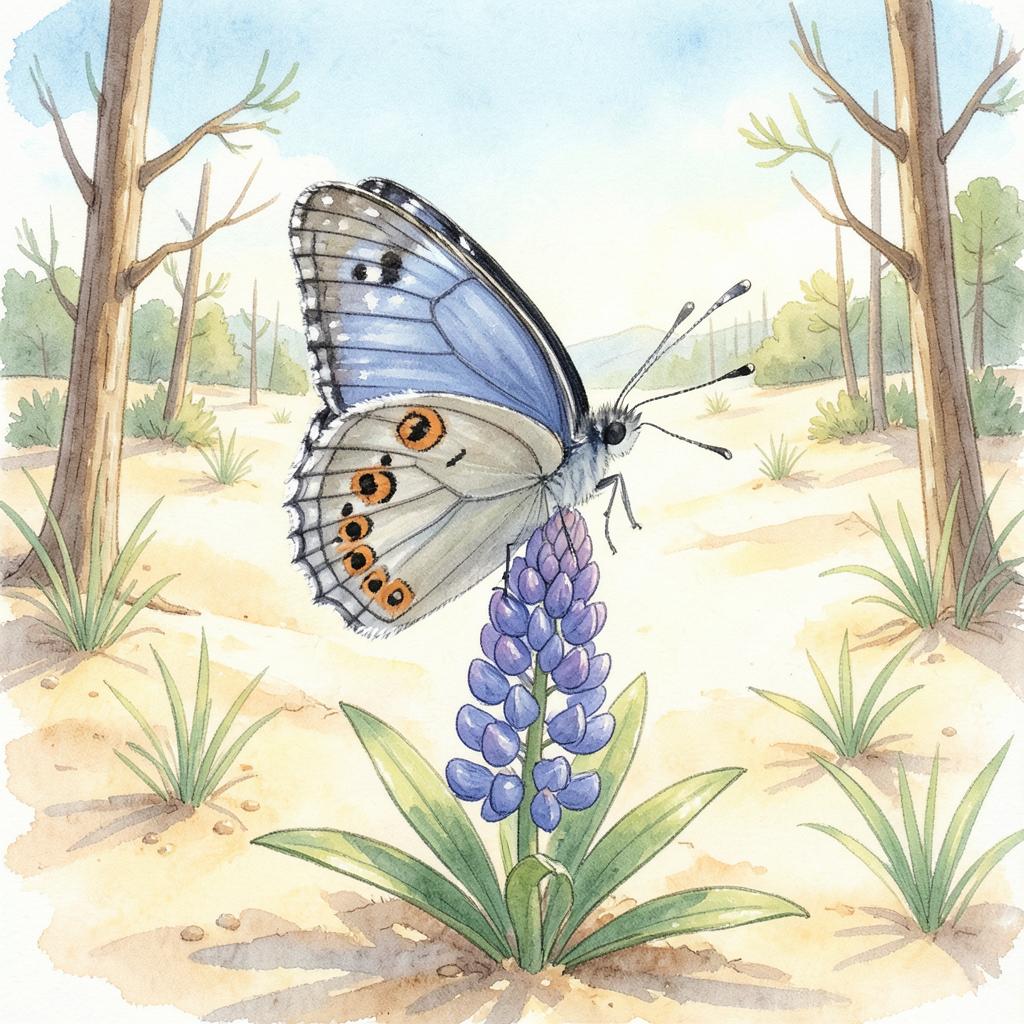
Illustrated Species Ambassador
Barrens — Karner Blue Butterfly
I'm Barrens, an illustrated ambassador for the Karner blue butterfly. My caterpillars eat one plant and one plant only: wild blue lupine.
- One fact worth knowing
- Karner blue caterpillars can feed on nothing but wild blue lupine, so the butterfly disappears wherever that single plant is lost.
- What I depend on
- I depend on sunny sandy pine barrens and oak savanna kept open by fire or careful clearing, because lupine will not grow in deep shade.
- My greatest threat
- My greatest threat is the loss of lupine as open barrens are developed or grow closed.
- One way you can help
- If you live within the historic range, plant wild blue lupine — Lupinus perennis, not garden lupines — and support prescribed burning that keeps barrens open.
This ambassador is an original illustration created for this project. It is an educational character, not a documentary image, and its statements follow the sourced record on this page. Artwork and rights record
Why this species matters
The Karner blue cannot exist without wild lupine, and wild lupine cannot persist without fire. Protecting the butterfly means restoring a disturbance process, not merely fencing off land — a lesson that applies across grassland and savanna conservation.
If it disappears: Its disappearance would signal the collapse of remaining oak savanna and pine barrens, habitats that already survive only in fragments.
Conservation status
- U.S. Endangered Species Act
- EndangeredListed 1992.Last verified 2026-09-08
- IUCN Red List
- Not separately assessed at the subspecies levelLast verified 2026-09-08
- State
- Endangered or of special concern in Wisconsin, Michigan, New York, New Hampshire, Indiana, Minnesota, and OhioLast verified 2026-09-08
Population
Population sizes are estimated by site rather than range-wide. Wisconsin holds the largest remaining populations; several states retain only small reintroduced or remnant colonies, and the species is extirpated from some historic states.
Trend: Unknown
As reported: USFWS recovery plan reporting and state monitoring programs
Source: U.S. Fish and Wildlife Service; state natural resources departments
Uncertainty: Numbers swing dramatically with weather; a single bad season can reduce a site population by most of its individuals.
Historical: Historically occurred in a band from Minnesota to Maine; extirpated from several states including Ohio, Illinois, Iowa, Pennsylvania, and Ontario.
Fragmentation: Remaining colonies are small, isolated, and unable to recolonize one another naturally.
Range and distribution
Historic range: Pine barrens and oak savanna from Minnesota east to New Hampshire and Maine, and southern Ontario.
Current range: Wisconsin, Michigan, Indiana, Minnesota, New York, New Hampshire, and Ohio through reintroduction.
Range contraction: Lost from the majority of its historic states.
Regions occupied
- Wisconsin sand barrens
- Michigan oak savanna
- Indiana Dunes
- Albany Pine Bush, New York
- Concord, New Hampshire
Habitat
Primary habitat: Sandy pine barrens, oak savanna, and dry prairie openings with wild blue lupine.
Breeding habitat: Eggs are laid on or near wild blue lupine (Lupinus perennis), the only plant the caterpillars eat.
Feeding habitat: Adults nectar on a range of savanna flowers including butterfly weed, horsemint, and blazing star.
Critical habitat: No critical habitat designated.
Habitat dependencies
- Wild blue lupine — the sole larval host plant
- Periodic fire or mowing to keep savanna open, since lupine disappears under shade
- Ant partners that tend and protect the caterpillars
Biology and ecology
A savanna pollinator and an indicator of functioning fire-dependent barrens habitat.
Key relationships: Caterpillars secrete a sugary fluid that attracts ants, which in turn defend them from predators — a mutualism that only works where the right ants are present.
Important adaptations: Two broods per year allow rapid rebuilding after a bad season, if habitat remains.
- Size
- Wingspan about one inch.
- Lifespan
- Adults live roughly five days.
- Diet
- Wild lupine as larvae; flower nectar as adults.
- Reproduction
- Two generations per year — a spring brood and a summer brood.
- Offspring
- Females lay dozens of eggs; the second brood's eggs overwinter.
- Breeding frequency
- Twice per year.
- Age at maturity
- Weeks from egg to adult.
Primary threats
Habitat loss
Pine barrens and oak savanna were converted to agriculture, plantations, and development.
Fire suppression
Without periodic fire, savanna closes into forest and wild lupine is shaded out.
Loss of host plant
The species cannot use any plant other than wild blue lupine; garden lupines will not substitute.
Fragmentation
Isolated colonies cannot be recolonized after a local extinction.
Deer browsing
High deer densities heavily browse lupine in some sites.
Climate change
Drought and heat events reduce lupine quality and desynchronize brood timing.
Invasive plants
Spotted knapweed and other invasives displace lupine in sandy openings.
Conservation and recovery
Programs and efforts
- USFWS Karner blue butterfly recovery plan
- Wisconsin Karner Blue Butterfly Habitat Conservation Plan, a large multi-partner private and public land agreement
- Captive rearing and reintroduction at Albany Pine Bush, Concord, and Ohio sites
- Prescribed fire and mowing regimes managed to avoid killing the butterflies present
- Lupine planting and savanna restoration
Protected areas
- Albany Pine Bush Preserve, New York
- Indiana Dunes National Park
- Necedah National Wildlife Refuge, Wisconsin
- Allegan State Game Area, Michigan
Legal protections
- Endangered Species Act
- Multiple state endangered listings
- Habitat Conservation Plan commitments
Measurable progress
- The Wisconsin Habitat Conservation Plan enrolled utilities, forestry companies, and agencies in coordinated management across a large area
- Reintroduction has restored the butterfly to New Hampshire and Ohio sites where it had been lost
Continuing challenges
- Prescribed fire must be applied in rotation so that unburned refuges always remain
- Habitat is small, scattered, and needs continual management
- Climate change disrupts the lupine-butterfly timing relationship
How people can help
What individuals can do
- Plant wild blue lupine (Lupinus perennis) if you live in the historic range — not the ornamental garden lupines sold in most nurseries
- Support prescribed fire programs, which are often misunderstood by neighbors
What communities can do
- Back savanna and barrens restoration on public land
- Support deer management where browsing suppresses lupine
Educational actions
- Use the ant mutualism to teach that species depend on relationships, not only on habitat
Habitat support
- Volunteer at pine barrens restoration workdays removing encroaching trees and invasive plants
Organizations and programs to learn about
- USFWS Midwest Region
- Albany Pine Bush Preserve Commission
- state departments of natural resources
Educational notes
- Named by novelist and lepidopterist Vladimir Nabokov, who first described it as a distinct subspecies.
- A species whose conservation requires deliberately setting fires.
Sources and references
- U.S. Fish and Wildlife Service — Karner Blue Butterfly — USFWS
- Albany Pine Bush Preserve — Karner Blue — Albany Pine Bush Preserve Commission
- NatureServe Explorer — NatureServe