Marine Life
Hawaiian Monk Seal
Neomonachus schauinslandi
One of the most endangered seals on earth, found only in Hawaii, and slowly increasing after decades of intensive individual care.
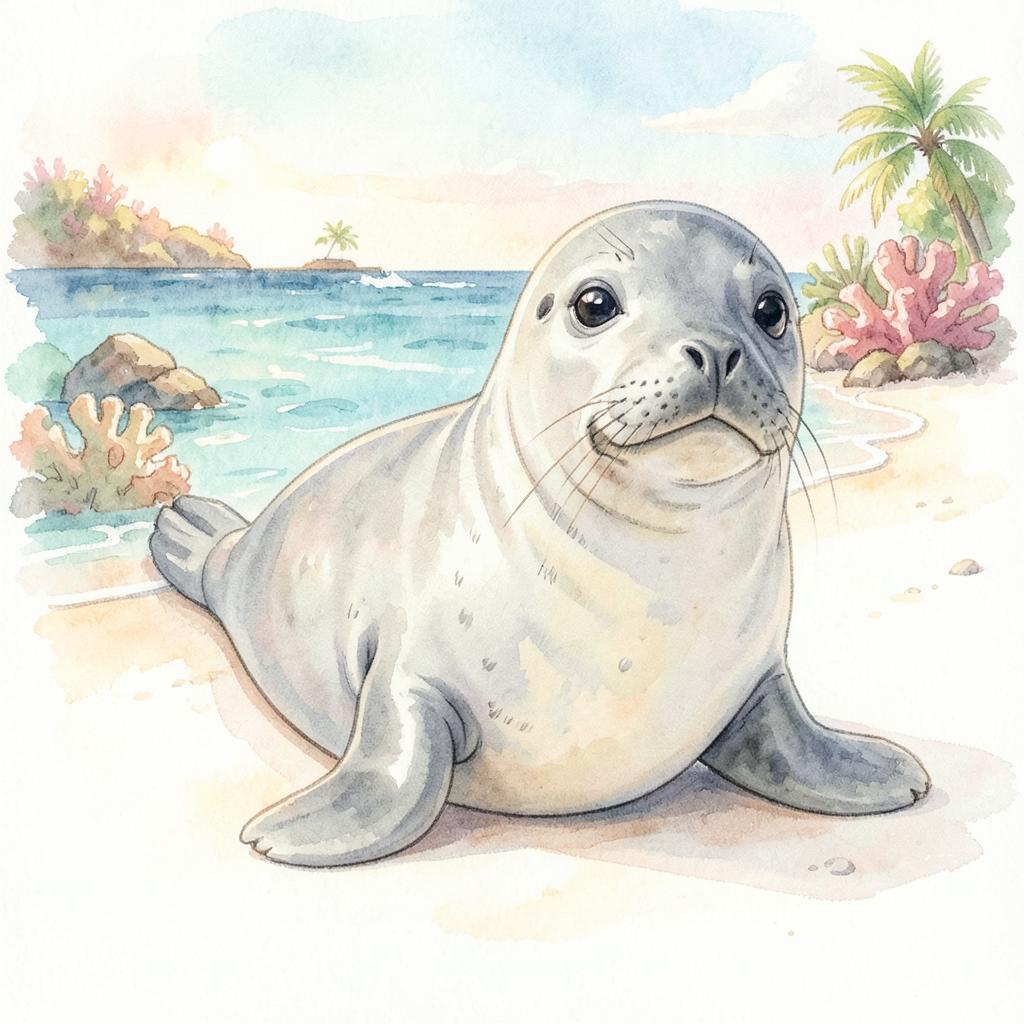
Illustrated Species Ambassador
Ilio — Hawaiian Monk Seal
I'm Ilio, an illustrated ambassador for the Hawaiian monk seal. When you see me lying still on the sand, I am not stranded. I am resting.
- One fact worth knowing
- The Hawaiian monk seal is one of the most endangered seals on earth, found only in Hawaii, and is slowly increasing after decades of intensive care for individual animals.
- What I depend on
- I depend on undisturbed beaches to pup and rest on, healthy reef prey, and low-lying atoll beaches that are not lost to rising seas.
- My greatest threat
- My greatest threats are entanglement in marine debris, limited food, and predation on pups.
- One way you can help
- Stay at least 50 feet from a resting seal and 150 feet from a mother with a pup, and keep cats indoors — toxoplasmosis carried from cat waste to the sea kills monk seals.
This ambassador is an original illustration created for this project. It is an educational character, not a documentary image, and its statements follow the sourced record on this page. Artwork and rights record
Why this species matters
Hawaiian monk seals are one of only two mammals native to Hawaii, and their population is growing only because individual animals are disentangled, treated, relocated, and in some cases hand-raised. It shows what recovery looks like when it must be done one animal at a time.
If it disappears: Hawaii would lose one of its two native mammals and the reef would lose a top predator; the closely related Caribbean monk seal is already extinct.
Cultural and regional note: Known in Hawaiian as ʻīlio-holo-i-ka-uaua, the dog that runs in rough water. Community volunteer networks protecting resting seals and pupping beaches are central to the recovery in the main islands.
Conservation status
- IUCN Red List
- EndangeredLast verified 2026-09-08
- U.S. Endangered Species Act
- EndangeredListed 1976, with designated critical habitat.Last verified 2026-09-08
- Marine Mammal Protection Act
- Depleted and strategic stockLast verified 2026-09-08
- Hawaii
- State endangeredLast verified 2026-09-08
Population
Roughly 1,500 individuals across the archipelago, with the majority in the Northwestern Hawaiian Islands and a growing subpopulation in the main Hawaiian Islands.
Trend: Increasing
As reported: NOAA Pacific Islands Fisheries Science Center annual assessment
Source: NOAA Fisheries Pacific Islands Regional Office
Uncertainty: Nearly every seal is individually identified and tracked, so this estimate is unusually reliable. The overall increase follows decades of decline and is modest.
Historical: Declined steeply through the twentieth century; the population fell by roughly 60 percent between the late 1950s and the 2010s before stabilizing.
Fragmentation: Two contrasting groups: the Northwestern Hawaiian Islands, remote and food-limited, and the main Hawaiian Islands, where seals face human interaction but better food availability.
Range and distribution
Historic range: Throughout the Hawaiian Archipelago.
Current range: Northwestern Hawaiian Islands and, increasingly, the main Hawaiian Islands.
Regions occupied
- Papahānaumokuākea Marine National Monument
- Kauai, Oahu, Molokai, Maui, and Hawaii Island
Habitat
Primary habitat: Coral reefs, atolls, and sandy beaches; forages in nearshore and deeper offshore waters.
Breeding habitat: Pups are born and nursed on sandy beaches for roughly five to six weeks.
Feeding habitat: Forages on reef fish, eels, octopus, and crustaceans, sometimes at considerable depth.
Critical habitat: Critical habitat designated across the archipelago including terrestrial and marine areas.
Habitat dependencies
- Undisturbed beaches for pupping and resting
- Healthy reef prey communities
- Beaches that are not lost to sea level rise at low-lying atolls
Biology and ecology
A reef apex predator and one of Hawaii's only two native mammals.
Important adaptations: Mothers fast entirely during the nursing period, losing a large share of body weight while the pup gains rapidly.
- Size
- About 7 to 7.5 feet.
- Weight
- Roughly 375 to 450 pounds; females slightly larger.
- Lifespan
- Around 25 to 30 years.
- Diet
- Reef and benthic fish, eels, octopus, squid, and crustaceans.
- Reproduction
- A single pup, nursed intensively while the mother fasts.
- Offspring
- One.
- Breeding frequency
- About once per year for successful females.
- Age at maturity
- Around five to nine years.
Primary threats
Marine debris entanglement
Derelict fishing nets and lines accumulate on Northwestern Hawaiian Island reefs and entangle seals, especially juveniles.
Food limitation
Juvenile survival in the Northwestern Hawaiian Islands is low, apparently because young seals struggle to find enough food.
Predation
Galapagos sharks prey on pups at certain atolls; targeted intervention has been used at specific sites.
Disease
Toxoplasmosis from cat feces washing into the ocean has killed a number of seals in the main Hawaiian Islands.
Human interaction
Fishing gear hooking, harassment, and intentional killings occur in the main islands.
Sea level rise
Low-lying atoll beaches used for pupping are being lost; East Island at French Frigate Shoals largely disappeared in a 2018 hurricane.
Small population
Low genetic diversity increases vulnerability to disease.
Conservation and recovery
Programs and efforts
- NOAA Hawaiian Monk Seal Research Program, including individual identification and health monitoring
- Marine debris removal expeditions to Papahānaumokuākea, removing many tons of derelict gear
- Translocation of undersized juveniles to better feeding areas and rehabilitation at Ke Kai Ola
- Volunteer beach response networks protecting resting and pupping seals in the main islands
- Vaccination programs against morbillivirus as a disease safeguard
Protected areas
- Papahānaumokuākea Marine National Monument, a UNESCO World Heritage Site
- Designated critical habitat across the archipelago
Legal protections
- Endangered Species Act
- Marine Mammal Protection Act
- Hawaii state endangered listing
- Monument protections
Measurable progress
- The population has grown modestly after decades of decline
- Rehabilitation and translocation have measurably increased juvenile survival, with roughly a third of living seals estimated to be alive because of direct intervention
- Volunteer networks have reduced disturbance in the main islands
Continuing challenges
- Toxoplasmosis is difficult to control
- Debris keeps accumulating on remote reefs
- Atoll habitat is being lost to sea level rise
How people can help
What individuals can do
- Stay at least 50 feet from resting seals, and 150 feet from a mother with a pup
- Keep cats indoors — toxoplasmosis from cat feces reaching the ocean kills monk seals
- Never leave fishing line or gear on beaches or in the water; report hooked seals immediately
- Report seal sightings to the NOAA hotline so volunteers can protect the site
What communities can do
- Support volunteer seal response networks
- Back marine debris removal funding
Educational actions
- Use the toxoplasmosis link to teach how an inland household decision reaches the ocean
Habitat support
- Support reef protection and debris removal in Papahānaumokuākea
Organizations and programs to learn about
- NOAA Pacific Islands Regional Office
- The Marine Mammal Center Ke Kai Ola
- Hawaii Marine Animal Response
Educational notes
- One of only two mammals native to Hawaii; the other is the Hawaiian hoary bat.
- The Caribbean monk seal, a close relative, is already extinct.
- An estimated third of living monk seals owe their survival to direct human intervention.
Sources and references
- IUCN Red List — Neomonachus schauinslandi — IUCN
- NOAA Fisheries — Hawaiian Monk Seal — NOAA Fisheries
- The Marine Mammal Center — Ke Kai Ola — The Marine Mammal Center