Plants
Haleakalā Silversword
Argyroxiphium sandwicense subsp. macrocephalum
A silver rosette plant that grows for decades on a Hawaiian volcano, flowers spectacularly once, and dies.
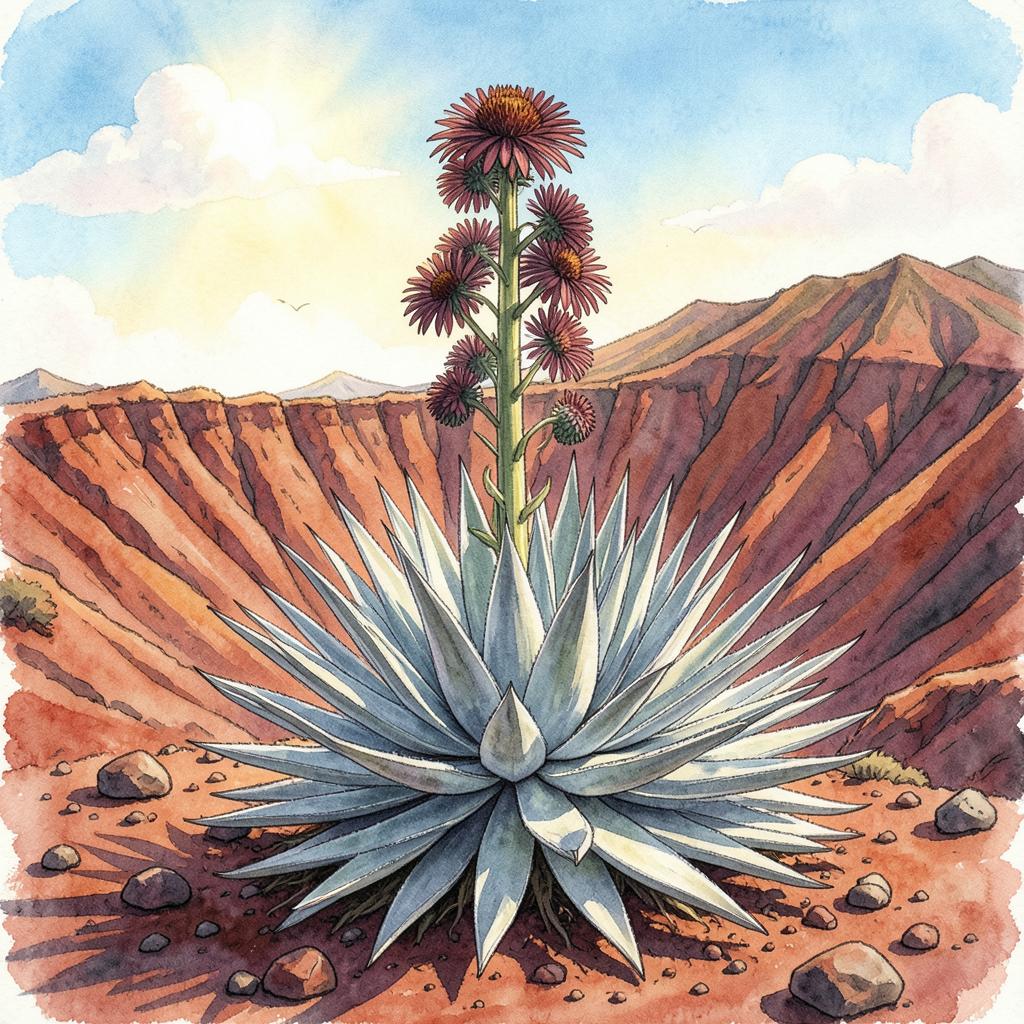
Illustrated Species Ambassador
Ahinahina — Haleakalā Silversword
I'm Ahinahina, an illustrated ambassador for the Haleakalā silversword. I grow on bare cinder near the top of a volcano, I flower once, and then my life is complete.
- One fact worth knowing
- The Haleakalā silversword grows for decades as a silver rosette, sends up a single tall flowering stalk, and dies after flowering once.
- What I depend on
- I depend on moisture from high-elevation cloud and trade winds, on native pollinators including endemic yellow-faced bees, and on undisturbed cinder — my shallow roots spread far wider than I look.
- My greatest threat
- My greatest threats are climate-driven drying, trampling, and invasive species.
- One way you can help
- If you visit Haleakalā, stay strictly on the marked trails and never lean on or pose against a silversword — the roots reach well beyond the visible plant.
This ambassador is an original illustration created for this project. It is an educational character, not a documentary image, and its statements follow the sourced record on this page. Artwork and rights record
Why this species matters
The silversword was nearly collected and trampled out of existence, then recovered dramatically under protection — and is now declining again because the mountain is getting drier. It shows both that protection works and that protection alone cannot address a changing climate.
If it disappears: Haleakalā's alpine ecosystem would lose its defining plant and the endemic insects that depend on it, and Hawaii would lose one of its most iconic native species.
Cultural and regional note: Known in Hawaiian as ʻāhinahina, meaning very gray. The plant holds cultural significance and its protection is part of the broader stewardship of Haleakalā as a sacred place.
Conservation status
- U.S. Endangered Species Act
- ThreatenedListed 1992.Last verified 2026-09-08
- Hawaii
- State listedLast verified 2026-09-08
- NatureServe
- ImperiledLast verified 2026-09-08
Population
Tens of thousands of plants within Haleakalā National Park, recovered from a low of a few thousand in the mid-twentieth century. However, monitoring has documented increased adult mortality and declining seedling establishment in recent decades, associated with a drying trend on the mountain.
Trend: Decreasing
As reported: National Park Service and U.S. Geological Survey long-term monitoring
Source: National Park Service Haleakalā National Park; U.S. Geological Survey Pacific Island Ecosystems Research Center
Uncertainty: This is an unusual case: the population is far larger than it was, and yet the trend is now negative. Both facts matter and neither should be reported alone.
Historical: Reduced to a few thousand plants by the 1920s through collection, trampling by visitors, and browsing by feral goats and cattle.
Fragmentation: Confined to the summit area of a single volcano.
Range and distribution
Historic range: The upper slopes and crater of Haleakalā volcano, Maui.
Current range: The same area, almost entirely within Haleakalā National Park.
Range contraction: Lower-elevation plants have declined most sharply as conditions dry.
Regions occupied
- Haleakalā summit and crater, Maui, Hawaii — roughly 6,900 to 9,800 feet elevation
Habitat
Primary habitat: Bare volcanic cinder and ash on the high slopes and crater floor of Haleakalā, in intense sun and extreme temperature swings.
Breeding habitat: Flowers once at the end of life, sending up a stalk that can exceed 6 feet with hundreds of flower heads.
Feeding habitat: Autotrophic.
Critical habitat: Protected within Haleakalā National Park.
Habitat dependencies
- Moisture from clouds and trade wind inversion at high elevation
- Native pollinators including endemic yellow-faced bees
- Undisturbed cinder substrate and a shallow, wide root system that trampling easily destroys
Biology and ecology
A keystone plant of the alpine cinder desert, supporting endemic insects including the Haleakalā flightless moth and native bees.
Important adaptations: Dense silver hairs reflect intense high-altitude sunlight and trap moisture, and the leaves are arranged to funnel dew and rain toward the roots. Roots spread shallowly and widely just beneath the surface — which is exactly why a single footstep off the trail can kill a plant.
- Size
- Rosette up to about 2 feet across; the flowering stalk can exceed 6 feet.
- Lifespan
- Typically several decades — commonly reported in the range of 10 to 50 years or more — before flowering.
- Diet
- Autotrophic.
- Reproduction
- Monocarpic — flowers exactly once, sets seed, and dies.
- Offspring
- A single flowering event can produce tens of thousands of seeds.
- Breeding frequency
- Once, at the end of life.
- Age at maturity
- Decades.
Primary threats
Climate change
A documented drying trend at the summit, linked to changes in the trade wind inversion, has increased adult mortality and reduced seedling survival, particularly at lower elevations.
Trampling
Visitors stepping off trail crush the shallow root system; a plant may look undamaged and die months later.
Invasive species
Introduced Argentine ants displace the native pollinators the plant depends on, and invasive plants compete for space.
Feral animals
Goats and cattle historically devastated the population; fencing has largely resolved this within the park.
Historic collection
Plants were once dug up and taken as souvenirs and sold, which nearly eliminated the species.
Loss of pollinators
Declines in endemic bees and other native pollinators reduce seed set.
Monocarpic life history
Flowering once and dying means a bad year for seedlings has consequences decades later.
Conservation and recovery
Programs and efforts
- Haleakalā National Park protection, fencing, and feral animal removal
- Long-term demographic monitoring plots tracking survival and recruitment
- Trail management, boardwalks, and visitor education to prevent trampling
- Outplanting of nursery-grown seedlings at appropriate elevations
- Research on climate-driven mortality and elevational shifts
- Argentine ant control to protect native pollinators
Protected areas
- Haleakalā National Park, an International Biosphere Reserve
Legal protections
- Endangered Species Act
- National Park Service protections
- Hawaii state listing
Measurable progress
- Population recovered from a few thousand plants to tens of thousands after fencing and protection
- One of the best long-term demographic datasets for any endangered plant
Continuing challenges
- Climate drying cannot be managed locally
- Visitor pressure is high
- Invasive ants are difficult to control
How people can help
What individuals can do
- If you visit Haleakalā, stay strictly on marked trails — the roots extend well beyond the visible plant
- Never touch, lean on, or pose against a silversword
- Clean your shoes and gear to avoid introducing invasive seeds and insects
What communities can do
- Support park funding for fencing, monitoring, and invasive species control
Educational actions
- Use the silversword to teach that a species can be both a recovery success and a current decline at the same time
Habitat support
- Support Hawaiian native plant restoration and invasive ant control programs
Organizations and programs to learn about
- Haleakalā National Park
- U.S. Geological Survey Pacific Island Ecosystems Research Center
- Hawaii Division of Forestry and Wildlife
Educational notes
- Grows for decades, flowers once, and dies.
- The silver hairs are a sunscreen and a water-collection system at once.
- A single step off the trail can kill a plant that has been growing since before you were born.