Marine Life
Green Sea Turtle
Chelonia mydas
A large sea turtle that grazes seagrass meadows, protected under the ESA as eleven separate populations with markedly different trajectories.
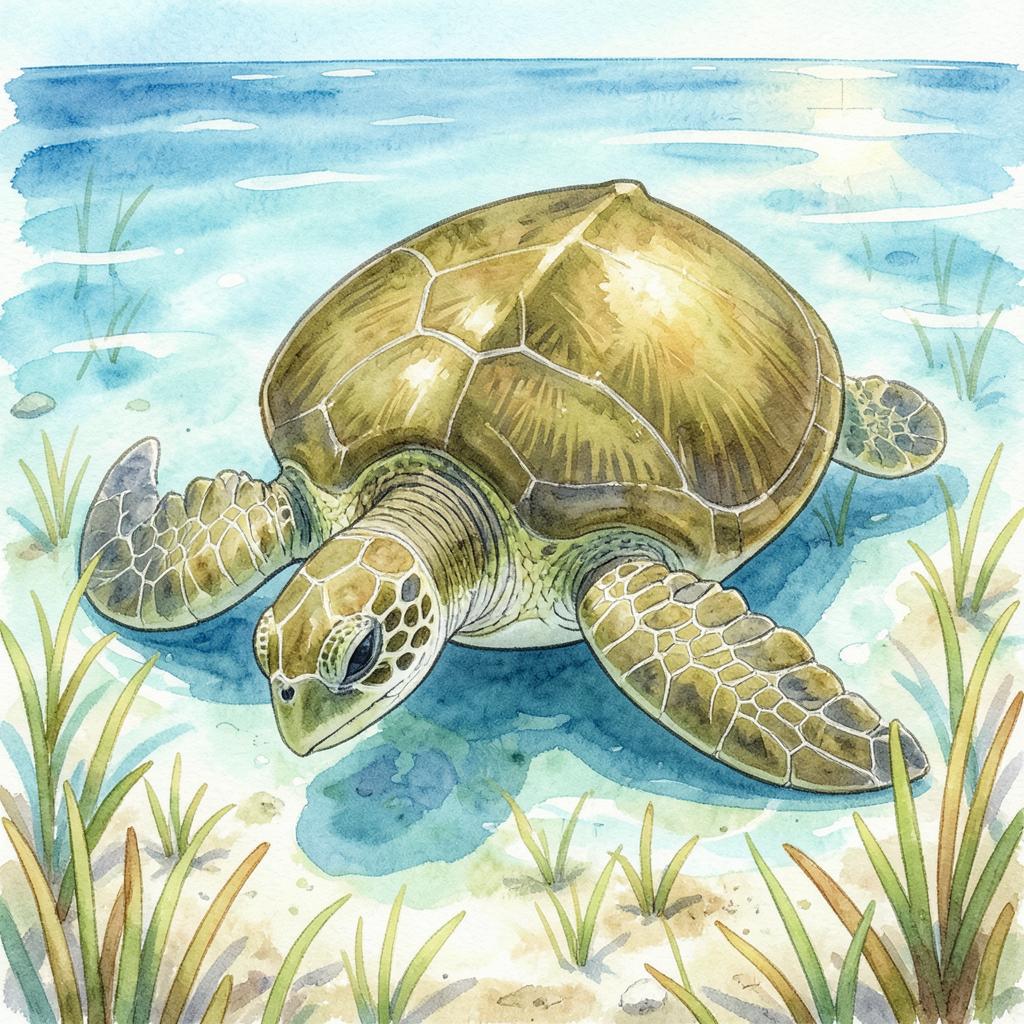
Illustrated Species Ambassador
Verdi — Green Sea Turtle
I'm Verdi, an illustrated ambassador for the green sea turtle. I crop seagrass the way cattle crop a field, and the meadow is healthier for it.
- One fact worth knowing
- Green sea turtles are protected under United States law as eleven separate populations, and those populations are heading in markedly different directions.
- What I depend on
- I depend on healthy seagrass meadows, dark undeveloped nesting beaches — artificial light sends hatchlings the wrong way — and migration routes free of nets and trawls.
- My greatest threat
- My greatest threats are bycatch, the loss of nesting beaches, and the tumour disease fibropapillomatosis.
- One way you can help
- Shield or switch off beachfront lights in nesting season, and fill in holes and clear chairs and gear off the sand at night so females and hatchlings are not trapped.
This ambassador is an original illustration created for this project. It is an educational character, not a documentary image, and its statements follow the sourced record on this page. Artwork and rights record
Why this species matters
Green turtles are the only large marine grazers of seagrass, and seagrass meadows are among the most efficient carbon-storing habitats on earth. Protecting the turtle protects the meadow, the fish nursery within it, and the carbon it holds.
If it disappears: Seagrass meadows would become overgrown and less productive, reducing nursery habitat for fish and weakening a significant coastal carbon store.
Cultural and regional note: Green turtles have deep cultural importance in Hawaiian and many Pacific and Caribbean traditions, and community-led protection has been central to several recoveries.
Conservation status
- IUCN Red List
- Endangered (global assessment)Last verified 2026-09-08
- U.S. Endangered Species Act
- Listed as eleven distinct population segments — three endangered and eight threatenedThe 2016 rule replaced the previous single global listing. Always specify the population when citing status.Last verified 2026-09-08
- CITES
- Appendix ILast verified 2026-09-08
Population
Global nesting female numbers are estimated in the low hundreds of thousands, distributed very unevenly. Several populations, including Florida and Hawaii, have increased substantially under protection, while others continue to decline.
Trend: Increasing
As reported: NOAA Fisheries status review and IUCN assessment; Florida Fish and Wildlife nesting counts
Source: NOAA Fisheries; USFWS; IUCN Red List; Florida Fish and Wildlife Conservation Commission
Uncertainty: The global trend is positive but the picture is genuinely mixed by region. Sea turtle populations are counted as nesting females or nests, not as total individuals.
Historical: Historically far more abundant; Caribbean populations were heavily harvested for meat and turtle soup.
Fragmentation: Eleven recognized distinct population segments with limited genetic exchange.
Range and distribution
Historic range: Tropical and subtropical waters worldwide.
Current range: Same global range, with nesting concentrated at specific beaches.
Migration: Adults migrate long distances between feeding grounds and natal nesting beaches, often thousands of miles.
Regions occupied
- Florida and the Caribbean
- Hawaii and the Central Pacific
- Eastern Pacific from Mexico to South America
- Indian Ocean and Southeast Asia
- Australia and the Coral Sea
Habitat
Primary habitat: Shallow coastal waters with seagrass meadows and algae beds.
Breeding habitat: Nests on sandy beaches, returning to the region where the female herself hatched.
Feeding habitat: Adults are largely herbivorous, grazing seagrass and algae; juveniles are more omnivorous.
Critical habitat: Critical habitat designated in Puerto Rico and other U.S. areas.
Habitat dependencies
- Healthy seagrass meadows
- Dark, undeveloped nesting beaches — artificial light disorients hatchlings
- Safe migratory corridors free of trawl and net entanglement
Biology and ecology
Grazing keeps seagrass meadows cropped and productive, much as grazing animals maintain grassland. Seagrass meadows in turn store carbon and shelter juvenile fish.
Important adaptations: Named for the greenish color of its body fat, a result of its plant-based diet. Sex of hatchlings is determined by nest temperature.
- Size
- Shell length commonly 3 to 4 feet.
- Weight
- Typically 240 to 420 pounds.
- Lifespan
- Estimated 60 to 70 years or more.
- Diet
- Seagrass and algae as adults; jellyfish, crustaceans, and invertebrates as juveniles.
- Reproduction
- Females come ashore to nest, laying multiple clutches in a season.
- Offspring
- Roughly 100 to 200 eggs per clutch, with several clutches per nesting season.
- Breeding frequency
- Females nest every two to five years.
- Age at maturity
- Very late — commonly 20 to 40 years.
Primary threats
Bycatch
Trawls, gillnets, and longlines drown turtles that cannot reach the surface.
Nesting beach loss
Coastal development, seawalls, and beach armoring eliminate nesting habitat.
Light pollution
Artificial lighting disorients hatchlings, drawing them inland instead of toward the sea.
Disease
Fibropapillomatosis causes debilitating tumors and is unusually prevalent in green turtles, with higher rates near nutrient-polluted waters.
Plastic and debris
Ingested plastic and entanglement in debris and abandoned gear kill turtles of all ages.
Climate change
Warmer nests produce predominantly female hatchlings, and sea level rise floods nesting beaches.
Egg harvest and poaching
Illegal take of eggs and adults continues in parts of the range.
Vessel strikes
Boat propeller injuries are common in developed coastal areas.
Conservation and recovery
Programs and efforts
- Turtle excluder devices required in U.S. shrimp trawl fisheries
- Nesting beach monitoring, nest marking, and hatchling protection programs
- Lighting ordinances requiring turtle-safe lighting in coastal towns
- Sea turtle stranding and rehabilitation networks
- International cooperation under the Inter-American Convention for the Protection of Sea Turtles
Protected areas
- Archie Carr National Wildlife Refuge, Florida
- Papahānaumokuākea Marine National Monument, Hawaii
- Tortuguero National Park, Costa Rica
- Great Barrier Reef Marine Park
Legal protections
- Endangered Species Act
- CITES Appendix I
- National protections across most range states
Measurable progress
- Florida green turtle nesting has increased dramatically since the 1980s
- The Hawaiian population recovered strongly following protection
- Turtle excluder devices substantially reduced trawl mortality
Continuing challenges
- Temperature-dependent sex determination under a warming climate
- Fibropapillomatosis has no cure
- Recovery is slow because maturity takes decades
How people can help
What individuals can do
- Turn off or shield beachfront lights during nesting season, and use amber turtle-safe bulbs
- Fill holes and remove chairs, tents, and gear from the beach at night — they trap nesting females and hatchlings
- Never disturb a nesting turtle or a marked nest
- Reduce single-use plastic and pick up beach litter
What communities can do
- Adopt and enforce coastal lighting ordinances
- Support nesting beach monitoring volunteer programs
Educational actions
- Use seagrass grazing to teach that a marine animal can be a habitat manager
Habitat support
- Support seagrass restoration and coastal water quality improvement
Organizations and programs to learn about
- NOAA Fisheries
- USFWS
- Sea Turtle Conservancy
- state sea turtle stranding networks
Educational notes
- Named for the color of its fat, not its shell.
- Nest temperature determines hatchling sex, making the species directly sensitive to warming.
- One of the clearest sea turtle conservation successes in some regions, while still declining in others.
Sources and references
- IUCN Red List — Chelonia mydas — IUCN
- NOAA Fisheries — Green Turtle — NOAA Fisheries
- U.S. Fish and Wildlife Service — Green Sea Turtle — USFWS