Pollinators
Franklin's Bumble Bee
Bombus franklini
A bumble bee with one of the smallest known ranges of any bee, not confirmed alive since 2006 despite intensive searching.
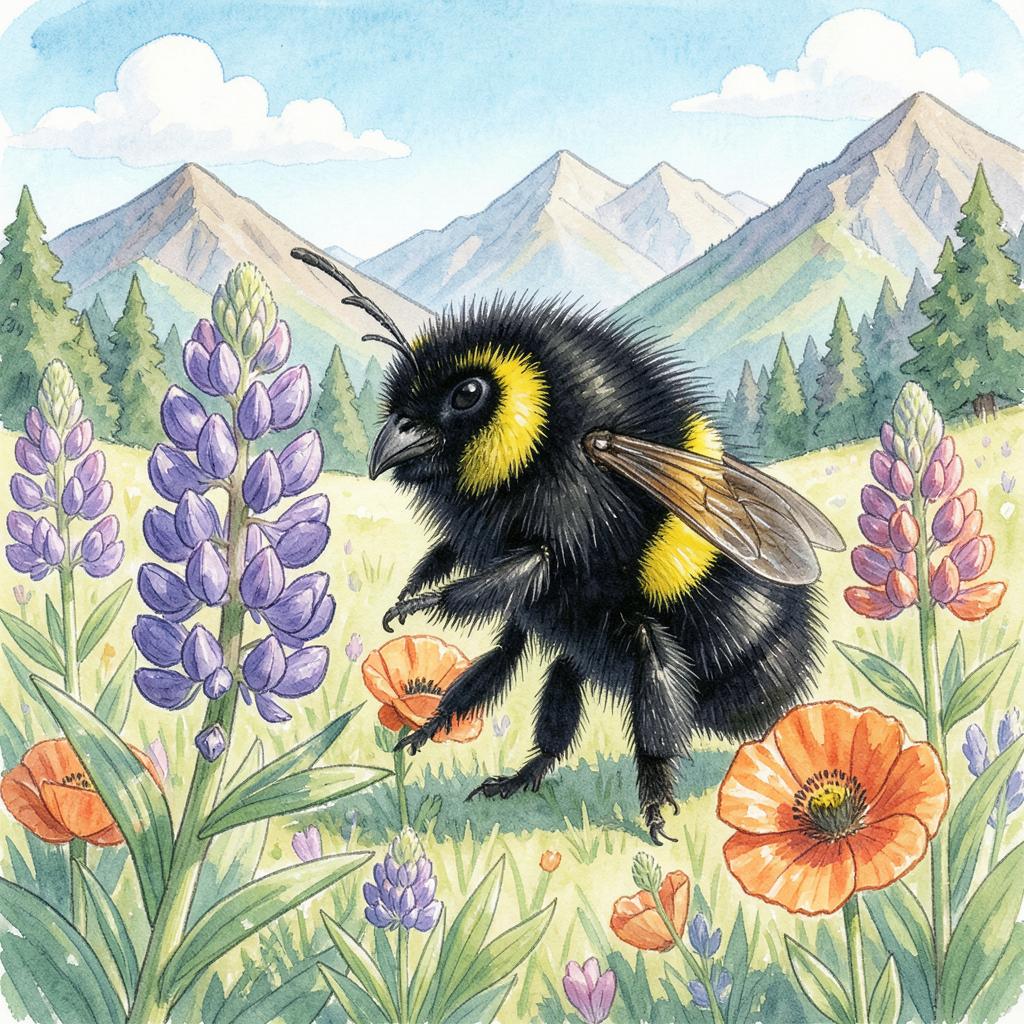
Illustrated Species Ambassador
Lupine — Franklin's Bumble Bee
I'm Lupine, an illustrated ambassador for Franklin's bumble bee. Nobody has confirmed one of us alive since 2006. People are still looking.
- One fact worth knowing
- Franklin's bumble bee has one of the smallest known ranges of any bee, and has not been confirmed alive since 2006 despite intensive searching.
- What I depend on
- I depend on meadow wildflower communities — lupine, poppy, horsemint — inside that very small historic range, and on undisturbed soil to nest in.
- My greatest threat
- My greatest threats are disease and an extremely small natural range.
- One way you can help
- If you are in southern Oregon or northern California, photograph bumble bees and submit the records; a verified photograph would be a genuinely significant discovery.
This ambassador is an original illustration created for this project. It is an educational character, not a documentary image, and its statements follow the sourced record on this page. Artwork and rights record
Why this species matters
Franklin's bumble bee is a sober reminder that a species can disappear while people are actively watching for it. It is also the strongest available argument for surveying and protecting insects before they become rare.
If it disappears: It would be among the first documented bumble bee extinctions in North America, and its meadow plant community would lose a specialized pollinator.
Conservation status
- IUCN Red List
- Critically Endangered (Possibly Extinct)Last verified 2026-09-08
- U.S. Endangered Species Act
- EndangeredListed in 2021.Last verified 2026-09-08
- NatureServe
- Critically Imperiled / Possibly ExtinctLast verified 2026-09-08
Population
Unknown, and possibly zero. The last confirmed observation was a single individual in 2006. Extensive targeted surveys since then have not produced a confirmed record.
Trend: Unknown
As reported: Last confirmed observation 2006; surveys ongoing since
Source: U.S. Fish and Wildlife Service; Xerces Society
Uncertainty: The species is not declared extinct. Because bumble bee colonies can persist at low density and detection is difficult, USFWS and IUCN keep it listed rather than delisted as extinct.
Historical: Recorded regularly through the 1990s, with a sharp drop beginning around 1998.
Fragmentation: Its entire known range was roughly 190 miles north to south and 70 miles east to west.
Range and distribution
Historic range: A small area of southern Oregon and northern California between the Coast Range and the Sierra-Cascade range.
Current range: No confirmed current occupancy.
Range contraction: Possibly complete.
Regions occupied
- Jackson, Josephine, Douglas, and Klamath counties, Oregon
- Siskiyou and Trinity counties, California
Habitat
Primary habitat: Meadows and open habitat with abundant lupine, poppy, horsemint, and other wildflowers.
Breeding habitat: Nests underground in abandoned rodent burrows.
Feeding habitat: Forages on a limited set of documented flowering plants within its small range.
Critical habitat: No critical habitat designated.
Habitat dependencies
- Meadow wildflower communities within its historic range
- Undisturbed soil for nesting
Biology and ecology
A native meadow pollinator within a very small geographic area.
Important adaptations: Distinguished by a distinctive U-shaped yellow marking on the thorax, unique among North American bumble bees.
- Size
- Workers roughly half an inch.
- Lifespan
- Annual colony cycle; queens live about a year.
- Diet
- Nectar and pollen.
- Reproduction
- Annual colony founded each spring by a single overwintered queen.
- Offspring
- Colony size unknown but presumably comparable to related species.
- Breeding frequency
- Once yearly.
Primary threats
Disease
Pathogen spillover from commercially reared bumble bees is the leading hypothesis for the abrupt decline in the late 1990s.
Extremely small range
A range this small offers no refuge from a single widespread threat.
Pesticides
Insecticide and herbicide use in and near its range reduces both bees and floral resources.
Habitat loss
Meadow conversion, grazing, and development reduced the flowering habitat within its narrow range.
Climate change
Drought and altered bloom timing further stress a species with no room to shift range.
Conservation and recovery
Programs and efforts
- Annual targeted survey effort by USFWS, Xerces Society, and university researchers
- Habitat protection and native meadow restoration in the historic range
- Public reporting and photographic verification requests for possible sightings
Protected areas
- Cascade-Siskiyou National Monument
- Rogue River-Siskiyou National Forest meadows
Legal protections
- Endangered Species Act listing in 2021
Measurable progress
- ESA listing has focused protection on the meadow habitat within the historic range, benefiting other pollinators
Continuing challenges
- No confirmed population to protect
- Detection of a rare bumble bee is genuinely difficult
- The disease cause cannot be reversed
How people can help
What individuals can do
- If you are in southern Oregon or northern California, photograph bumble bees and submit records — a verified photograph would be a significant discovery
- Plant native meadow wildflowers within the historic range
What communities can do
- Protect and restore meadow habitat in Jackson, Josephine, Douglas, Siskiyou, and Trinity counties
Educational actions
- Learn to identify the U-shaped thoracic marking that separates this species from its close relatives
Habitat support
- Support meadow restoration and grazing management on public land in the historic range
Organizations and programs to learn about
- Xerces Society
- USFWS Oregon Fish and Wildlife Office
Educational notes
- Among the smallest known ranges of any bumble bee on earth.
- Not declared extinct — the distinction between 'not found' and 'gone' matters scientifically.
Sources and references
- IUCN Red List — Bombus franklini — IUCN
- U.S. Fish and Wildlife Service — Franklin's Bumble Bee — USFWS
- Xerces Society — Franklin's Bumble Bee — Xerces Society