Plants
Franklin Tree
Franklinia alatamaha
A flowering tree extinct in the wild since the early 1800s, surviving only because two botanists collected seed before it disappeared.
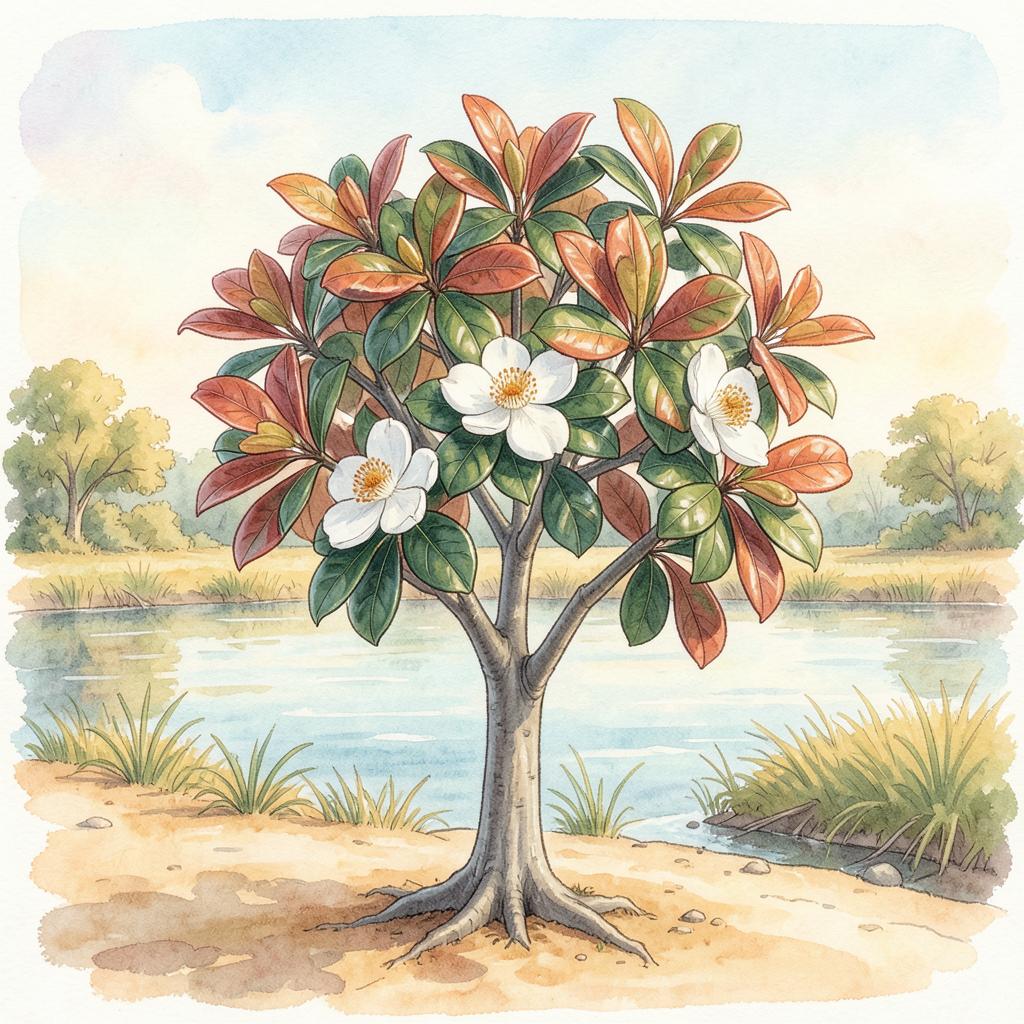
Illustrated Species Ambassador
Altamaha — Franklin Tree
I'm Altamaha, an illustrated ambassador for the Franklin tree. You will not find me in any wild place. Every one of me alive today was planted.
- One fact worth knowing
- Franklinia alatamaha has been extinct in the wild since the early 1800s. It survives only because two botanists collected seed before it disappeared from its Georgia river bottomland.
- What I depend on
- In cultivation I need well-drained acidic soil free of the root pathogens that thrive in old agricultural ground. My original wild habitat was sandy bottomland along a coastal river.
- My greatest threat
- I am already gone from the wild; what remains faces disease and very narrow genetics.
- One way you can help
- Plant a Franklin tree if your soil and climate suit it, and support botanical gardens and seed banks — they are the reason this species still exists at all.
This ambassador is an original illustration created for this project. It is an educational character, not a documentary image, and its statements follow the sourced record on this page. Artwork and rights record
Why this species matters
The Franklin tree exists today only because two people collected seed and grew it before the wild population vanished. It is simultaneously the strongest argument for seed banking and botanical gardens, and a reminder that a species saved in cultivation is not the same as a species saved.
If it disappears: The species is already ecologically lost. What remains at risk is its genetic material, held in a very narrow cultivated population.
Cultural and regional note: Named by William Bartram for Benjamin Franklin, a friend of his father. Bartram's Garden in Philadelphia still grows descendants of the original collection.
Conservation status
- IUCN Red List
- Extinct in the WildLast verified 2026-09-08
- U.S. Endangered Species Act
- Not listedNot listed because no wild population exists to protect.Last verified 2026-09-08
- NatureServe
- Presumed Extinct in the WildLast verified 2026-09-08
Population
Zero in the wild. Every living Franklin tree — many thousands in gardens, arboreta, and nurseries worldwide — descends from seed collected by John and William Bartram in the eighteenth century.
Trend: Stable
As reported: Last confirmed wild observation 1803
Source: Bartram's Garden; Morris Arboretum; IUCN Red List; historic botanical records
Uncertainty: This is one of the very few plant species with a precisely documented extinction in the wild and a precisely documented reason it still exists at all.
Historical: Discovered by John and William Bartram in 1765 along the Altamaha River in Georgia, in a stand covering only a few acres. Never found anywhere else. Last confirmed in the wild in 1803.
Fragmentation: The entire living population is cultivated and genetically extremely narrow.
Range and distribution
Historic range: A small area along the Altamaha River in McIntosh County, Georgia — the only place it was ever recorded.
Current range: Cultivation only, in gardens and arboreta across North America, Europe, and elsewhere.
Range contraction: Complete loss from the wild.
Regions occupied
- Historic: Altamaha River, Georgia
- Current: cultivated worldwide
Habitat
Primary habitat: Historically recorded in sandy bottomland along a coastal river.
Breeding habitat: Produces large white camellia-like flowers with yellow stamens in late summer and autumn.
Feeding habitat: Autotrophic.
Habitat dependencies
- In cultivation, well-drained acidic soil free of the root pathogens that thrive in agricultural soils
Biology and ecology
Historically a component of Georgia coastal bottomland flora; today an ornamental with no wild ecological role.
Important adaptations: Flowers very late in the season, and its leaves turn deep red in autumn while it is still in bloom.
- Size
- A small tree or large shrub, typically 10 to 25 feet.
- Lifespan
- Decades in cultivation.
- Diet
- Autotrophic.
- Reproduction
- Insect-pollinated; sets viable seed in cultivation.
- Offspring
- Seed capsules with modest seed numbers.
- Breeding frequency
- Flowers annually in late summer.
Primary threats
Already extinct in the wild
No wild population has existed since the early nineteenth century; the cause has never been definitively established.
Disease
Cultivated Franklin trees are highly susceptible to Phytophthora root rot, which is widespread in soils where cotton was formerly grown — one leading hypothesis for the original extinction.
Extremely low genetic diversity
All living plants descend from a single small seed collection, leaving almost no genetic variation.
Historic collection pressure
Collection of the remaining wild plants may have contributed to the final loss.
Flooding and habitat change
Changes in the Altamaha floodplain may have affected the original tiny stand.
Cultivation difficulty
The species is notoriously hard to grow well, limiting the size of the surviving population.
Conservation and recovery
Programs and efforts
- Ex situ conservation in botanical gardens and arboreta worldwide
- Bartram's Garden stewardship of trees descended from the original collection
- Genetic studies of the surviving cultivated population
- Repeated searches of the Altamaha region for any surviving wild plants
- Nursery propagation making the species widely available in horticulture
Protected areas
- Bartram's Garden, Philadelphia
- Arboreta and botanical gardens across North America and Europe
Legal protections
- No wild population exists to protect legally
Measurable progress
- The species survives entirely because of eighteenth-century seed collection and continuous cultivation since
- It is widely available in horticulture, keeping thousands of individuals alive
Continuing challenges
- No wild habitat to return to with confidence
- Extremely narrow genetics
- High susceptibility to soil pathogens
How people can help
What individuals can do
- Plant a Franklin tree if your soil and climate suit it — every cultivated tree keeps the species alive
- Support botanical gardens and seed banks, which are the reason species like this still exist
What communities can do
- Include rare and ex situ conserved species in public garden plantings
Educational actions
- Use the Franklin tree to teach both the value and the limits of ex situ conservation — the species is alive, but it is not recovered
Habitat support
- Support Altamaha River corridor conservation in Georgia
Organizations and programs to learn about
- Bartram's Garden
- Botanic Gardens Conservation International
- American Public Gardens Association
Educational notes
- Every Franklin tree on earth traces to one seed collection made in the 1700s.
- Last seen in the wild in 1803, and never found anywhere else despite two centuries of searching.
- Blooms in late summer and autumn, often while its own leaves are turning red.
Sources and references
- IUCN Red List — Franklinia alatamaha — IUCN
- Bartram's Garden — Franklinia — Bartram's Garden
- Botanic Gardens Conservation International — BGCI