Fish and Aquatic Life
European Eel
Anguilla anguilla
A fish that crosses the Atlantic twice in one lifetime, now critically endangered after recruitment collapsed by more than 90 percent.
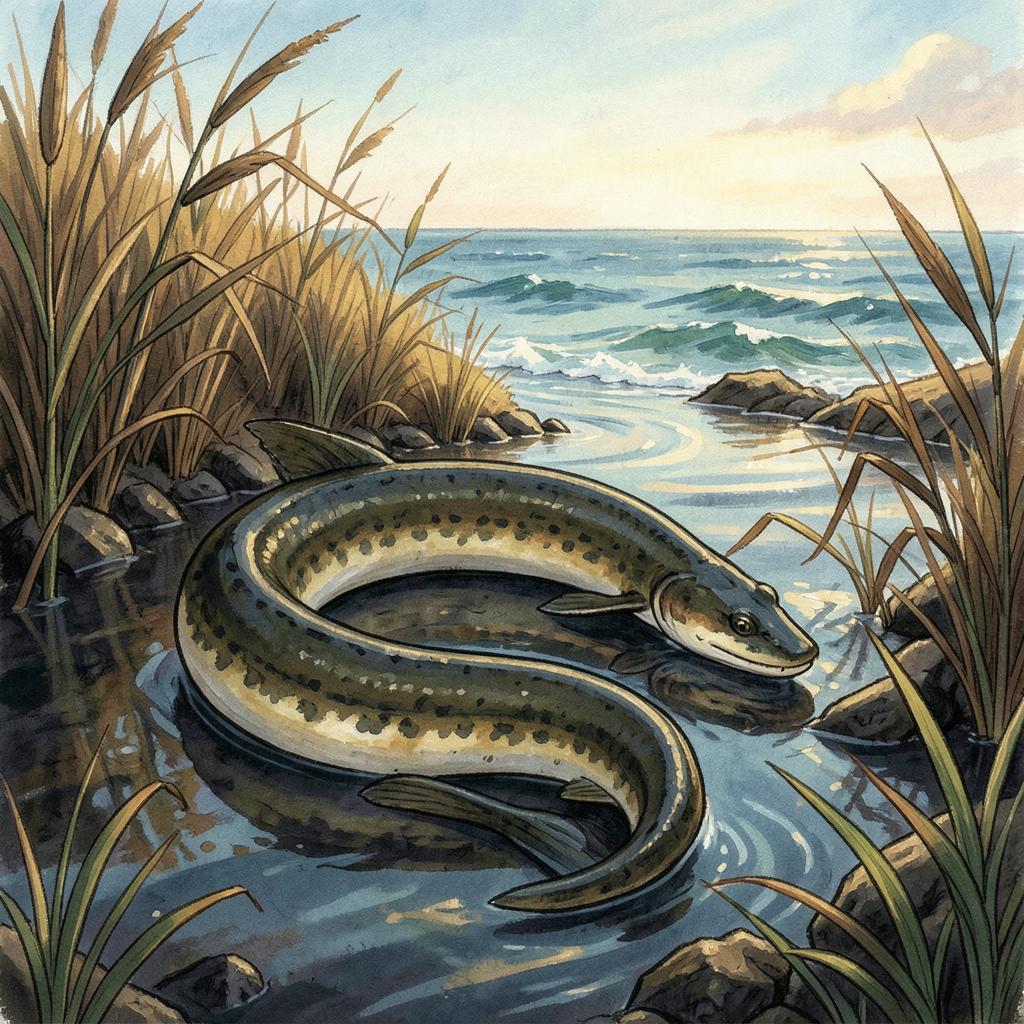
Illustrated Species Ambassador
Sarga — European Eel
I'm Sarga, an illustrated ambassador for the European eel. I crossed the Atlantic as a leaf-shaped larva, and I will cross it again to spawn.
- One fact worth knowing
- The European eel crosses the Atlantic twice in one lifetime, and is now critically endangered after recruitment of young eels collapsed by more than 90 percent.
- What I depend on
- I depend on rivers, lakes, estuaries and lagoons for my long growth phase, on clean inland water, and on being able to travel up and down rivers freely.
- My greatest threat
- My greatest threats are barriers to migration and the trafficking of juvenile eels.
- One way you can help
- Avoid eel products unless the source is verified and legal, and understand that farmed eel still starts as a wild-caught juvenile.
This ambassador is an original illustration created for this project. It is an educational character, not a documentary image, and its statements follow the sourced record on this page. Artwork and rights record
Why this species matters
The European eel's life cycle spans an ocean and every river system in Europe. Because it reproduces only once, at the end of a journey of thousands of miles, every barrier along the way subtracts directly from the next generation.
If it disappears: Losing it would break a unique ocean-to-continent nutrient link and remove a species of major cultural and culinary significance across Europe.
Cultural and regional note: Eel fishing traditions are centuries old across Europe, and glass eels are among the most valuable wildlife products by weight, which drives large-scale trafficking.
Conservation status
- IUCN Red List
- Critically EndangeredLast verified 2026-09-08
- CITES
- Appendix IIListed in 2007; the EU has suspended commercial exports outside the union.Last verified 2026-09-08
- European Union
- Subject to the EU Eel Regulation requiring national eel management plansLast verified 2026-09-08
Population
Recruitment of glass eels arriving in European waters has fallen by roughly 90–95 percent or more compared with 1980 levels, and remains at a small fraction of historic levels.
Trend: Decreasing
As reported: ICES stock assessment and IUCN Red List assessment
Source: International Council for the Exploration of the Sea (ICES); IUCN Red List
Uncertainty: Recruitment indices, not total population, are the standard measure. ICES has advised that all human-caused mortality be reduced to as close to zero as possible.
Historical: Glass eel runs were once so dense that they supported large seasonal fisheries across Europe.
Range and distribution
Historic range: Rivers, lakes, and coastal waters across Europe and North Africa, with a spawning area in the Sargasso Sea.
Current range: Same range, greatly reduced in density, with many inland waters now inaccessible.
Migration: Larvae drift roughly 3,000 miles from the Sargasso Sea to Europe, mature in fresh and brackish water for years or decades, then return across the Atlantic to spawn and die.
Range contraction: Dams and weirs have cut off large areas of inland habitat.
Regions occupied
- Europe from Scandinavia to the Mediterranean
- North Africa
- Sargasso Sea (spawning)
Habitat
Primary habitat: Rivers, lakes, estuaries, and coastal lagoons during the long growth phase.
Breeding habitat: Spawns in the Sargasso Sea; no adult has ever been directly observed spawning in the wild.
Feeding habitat: Nocturnal predator of invertebrates and fish in fresh and brackish water.
Habitat dependencies
- Unobstructed river passage in both directions
- Ocean current patterns carrying larvae to Europe
- Clean inland water free of contaminants
Biology and ecology
A major predator and prey species linking Atlantic ocean and European freshwater ecosystems.
Important adaptations: Transforms through several distinct life stages — leptocephalus larva, transparent glass eel, yellow eel, and silver eel — each physiologically suited to a different environment.
- Size
- Commonly 2–4 feet as a mature adult.
- Weight
- Typically 2–15 pounds.
- Lifespan
- Highly variable — from about 5 to over 20 years, and much longer in some cases, before migrating to spawn.
- Diet
- Invertebrates, fish, and carrion.
- Reproduction
- Spawns once at the end of life in the Sargasso Sea, then dies.
- Offspring
- Millions of eggs per female.
- Breeding frequency
- Once in a lifetime.
- Age at maturity
- Highly variable, driven by growth conditions rather than age.
Primary threats
Dams and barriers
Weirs, dams, and pumping stations block upstream migration of juveniles and kill descending adults in turbines.
Wildlife trafficking
Glass eels are smuggled from Europe to Asian aquaculture markets in what Europol describes as one of the largest wildlife trafficking operations on earth.
Overharvest
Historic and continuing fishing of glass eels and adults removes fish before they can spawn.
Disease and parasites
The introduced swim bladder parasite Anguillicola crassus impairs the eel's ability to make the deep Atlantic spawning migration.
Pollution
Contaminants accumulate in the eel's fatty tissue and are mobilized during the long spawning migration.
Climate change
Changes in ocean currents may affect larval transport from the Sargasso Sea to Europe.
Habitat loss
Wetland drainage removed large areas of historic growth habitat.
Conservation and recovery
Programs and efforts
- EU Eel Regulation requiring national eel management plans and escapement targets
- CITES Appendix II listing and the EU export suspension
- Europol and national enforcement operations against glass eel trafficking
- Eel passes and barrier removal on European rivers
- Restocking programs moving glass eels to inland waters
Protected areas
- Protected river and wetland systems across Europe under the EU Habitats and Water Framework Directives
Legal protections
- CITES Appendix II
- EU Eel Regulation
- National fishing restrictions and closed seasons
Measurable progress
- Large trafficking networks have been prosecuted
- Thousands of migration barriers have been removed or fitted with eel passes
Continuing challenges
- Recruitment remains at historic lows
- The species cannot be bred in captivity at commercial scale, so aquaculture depends on wild-caught juveniles
- Trafficking is highly profitable
How people can help
What individuals can do
- Avoid eel products unless the source is verified and legal
- Understand that farmed eel still begins as a wild-caught juvenile — aquaculture does not remove pressure on wild stocks
What communities can do
- Support barrier removal and eel pass installation on local rivers
Educational actions
- Use the eel's four life stages and transatlantic migration to teach the complexity of a single life cycle
Habitat support
- Support wetland restoration and river connectivity projects
Organizations and programs to learn about
- ICES
- Sustainable Eel Group
- national fisheries and environment agencies
Educational notes
- No one has ever observed a European eel spawning in the wild — a genuine remaining mystery in biology.
- Farmed eel is not bred in captivity; every farmed eel started as a wild juvenile.
Sources and references
- IUCN Red List — Anguilla anguilla — IUCN
- CITES Appendices — CITES
- ICES advice on European eel — International Council for the Exploration of the Sea