Fish and Aquatic Life
Devils Hole Pupfish
Cyprinodon diabolis
The rarest fish in the world, living entirely in one water-filled limestone cavern in the Nevada desert.
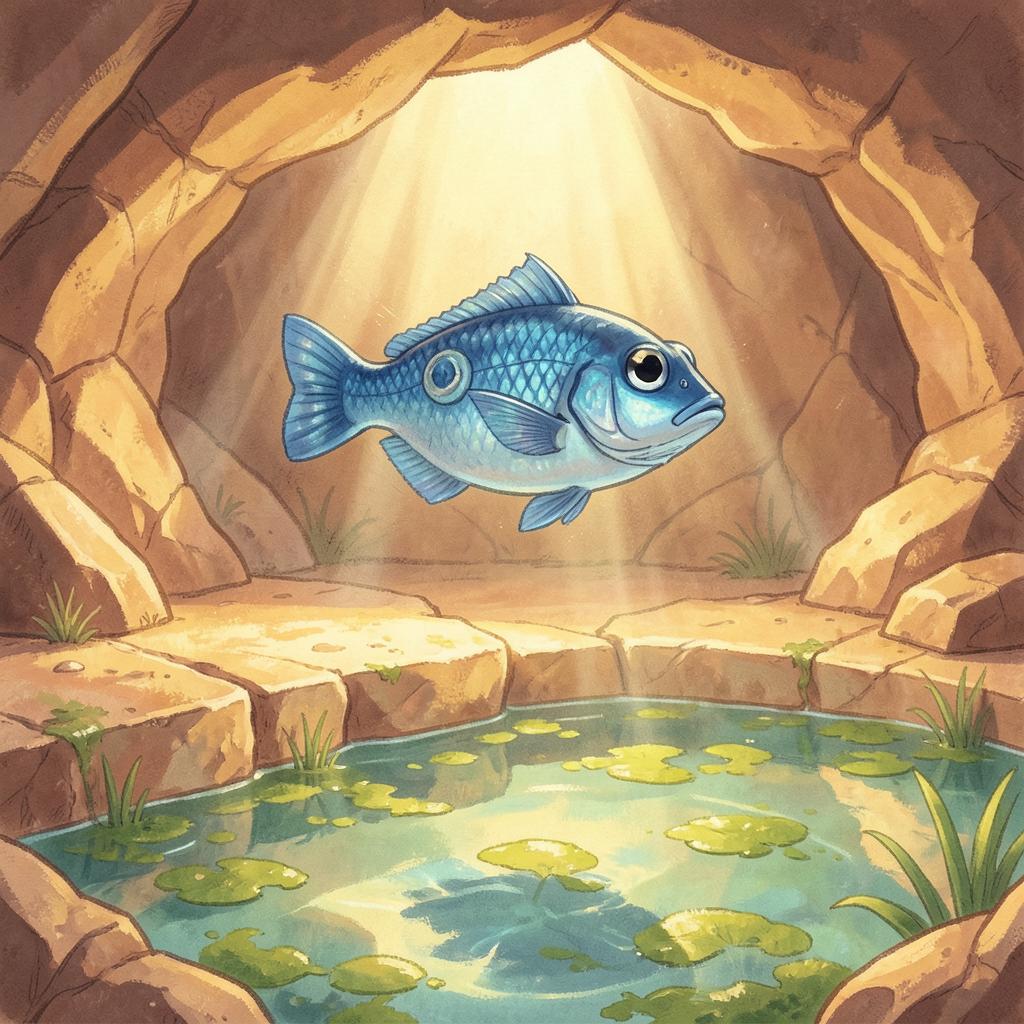
Illustrated Species Ambassador
Solo — Devils Hole Pupfish
I'm Solo, an illustrated ambassador for the Devils Hole pupfish. My entire species lives in one water-filled limestone cavern in Nevada.
- One fact worth knowing
- The Devils Hole pupfish is the rarest fish in the world, living only in a single geothermally warmed cavern pool in the Nevada desert.
- What I depend on
- I depend on the groundwater staying high enough to keep the shallow shelf underwater, on water near 93°F with naturally low oxygen, and on algae growing on that shelf.
- My greatest threat
- My greatest threat is groundwater depletion, made worse by having only one site in the world.
- One way you can help
- Support groundwater conservation in the Amargosa Valley region — the water level in my pool is the water level in the aquifer.
This ambassador is an original illustration created for this project. It is an educational character, not a documentary image, and its statements follow the sourced record on this page. Artwork and rights record
Why this species matters
The Devils Hole pupfish produced the 1976 U.S. Supreme Court decision in Cappaert v. United States, which established that a federal land reservation carries with it an implied reservation of the groundwater needed to fulfill its purpose. One tiny fish reshaped American water law.
If it disappears: Extinction would end the world's most geographically restricted vertebrate and remove the living subject of a landmark water rights precedent.
Conservation status
- IUCN Red List
- Critically EndangeredLast verified 2026-09-08
- U.S. Endangered Species Act
- EndangeredListed 1967.Last verified 2026-09-08
- Nevada
- State protectedLast verified 2026-09-08
Population
Typically between about 100 and 200 fish, counted twice yearly by divers and surface observers. The recorded low was 35 observed fish in spring 2013; recent counts have been among the highest in two decades.
Trend: Increasing
As reported: National Park Service, USFWS, and Nevada Department of Wildlife biannual counts, most recent seasons
Source: National Park Service Death Valley National Park; U.S. Fish and Wildlife Service
Uncertainty: Counts are direct observations of essentially the entire population — an unusually complete census, but numbers swing seasonally between spring lows and fall highs.
Historical: The species has persisted in this single location for thousands of years.
Fragmentation: The entire wild species occupies one water body, with a refuge population maintained nearby.
Range and distribution
Historic range: Devils Hole only — a water-filled cavern connected to a deep regional aquifer.
Current range: Devils Hole, plus a purpose-built refuge tank at the Ash Meadows Fish Conservation Facility.
Range contraction: None; the range has always been minute.
Regions occupied
- Nye County, Nevada — a detached unit of Death Valley National Park
Habitat
Primary habitat: A geothermally warmed limestone cavern pool roughly 70 feet long at the surface, opening into a flooded cave system of unknown depth.
Breeding habitat: Spawning and feeding occur almost entirely on a shallow rock shelf about 10 by 20 feet in area.
Feeding habitat: Grazes algae and diatoms and eats invertebrates on the shelf.
Critical habitat: The site itself is federally protected as a detached unit of Death Valley National Park.
Habitat dependencies
- Groundwater level high enough to keep the shallow shelf submerged
- Stable water temperature near 93°F and naturally low dissolved oxygen
- Algal growth on the shelf
Biology and ecology
The top consumer in an extremely simple, isolated ecosystem.
Important adaptations: Survives at temperatures and oxygen levels lethal to most fish, and lacks pelvic fins — a distinctive trait of this species.
- Size
- About 1 inch long.
- Weight
- Negligible.
- Lifespan
- Roughly one year — unusually short for a fish.
- Diet
- Algae, diatoms, and small invertebrates.
- Reproduction
- Spawns year-round on the shallow shelf, with peaks in spring.
- Offspring
- Very small numbers of eggs; recruitment is naturally low.
- Breeding frequency
- Continuous, but limited by shelf area and food.
- Age at maturity
- A few months.
Primary threats
Groundwater depletion
Agricultural and municipal pumping in the regional aquifer lowers the water level over the spawning shelf, directly reducing habitat area.
Extremely small range
One flash flood, contaminant spill, or vandalism event could affect the entire species.
Climate change
Regional drought and warming affect aquifer recharge and water chemistry.
Vandalism
In 2016 trespassers entered Devils Hole and at least one pupfish died; the site is now heavily secured.
Low genetic diversity
A permanently tiny population carries inherent genetic risk.
Food supply variability
Algae growth on the shelf drives population swings, and shelf conditions are sensitive to small water level changes.
Conservation and recovery
Programs and efforts
- National Park Service, USFWS, and Nevada Department of Wildlife joint management
- Ash Meadows Fish Conservation Facility refuge tank replicating Devils Hole conditions
- Supplemental feeding and shelf management during low-food periods
- Groundwater monitoring and pumping limits enforced under the Cappaert precedent
- 24-hour surveillance and physical security at the site
Protected areas
- Devils Hole, a detached unit of Death Valley National Park
- Ash Meadows National Wildlife Refuge
Legal protections
- Endangered Species Act
- Cappaert v. United States (1976) groundwater protection
- National Park Service site protection
Measurable progress
- Recent counts are among the highest recorded in more than twenty years
- A functioning refuge population now exists as insurance
Continuing challenges
- Regional groundwater demand continues
- The population will always be small
- Any single event could be catastrophic
How people can help
What individuals can do
- Support groundwater conservation in the Amargosa Valley region
- Never attempt to enter Devils Hole; it is a felony and it has killed people
What communities can do
- Back regional groundwater management that accounts for federally protected water rights
Educational actions
- Use Cappaert v. United States to teach how endangered species law intersects with water rights
- Watch the live-streamed Devils Hole counts and monitoring the Park Service publishes
Habitat support
- Support Ash Meadows spring ecosystem protection, which shelters many other endemic species
Organizations and programs to learn about
- Death Valley National Park
- USFWS Nevada Fish and Wildlife Office
- Nevada Department of Wildlife
Educational notes
- Probably the smallest natural range of any vertebrate on earth.
- A rare case where a single species changed national law.
Sources and references
- IUCN Red List — Cyprinodon diabolis — IUCN
- National Park Service — Devils Hole — National Park Service
- U.S. Fish and Wildlife Service — Devils Hole Pupfish — USFWS