Fish and Aquatic Life
Colorado Pikeminnow
Ptychocheilus lucius
The largest minnow in North America, historically reaching six feet, now confined to remnant reaches of the Colorado River basin.
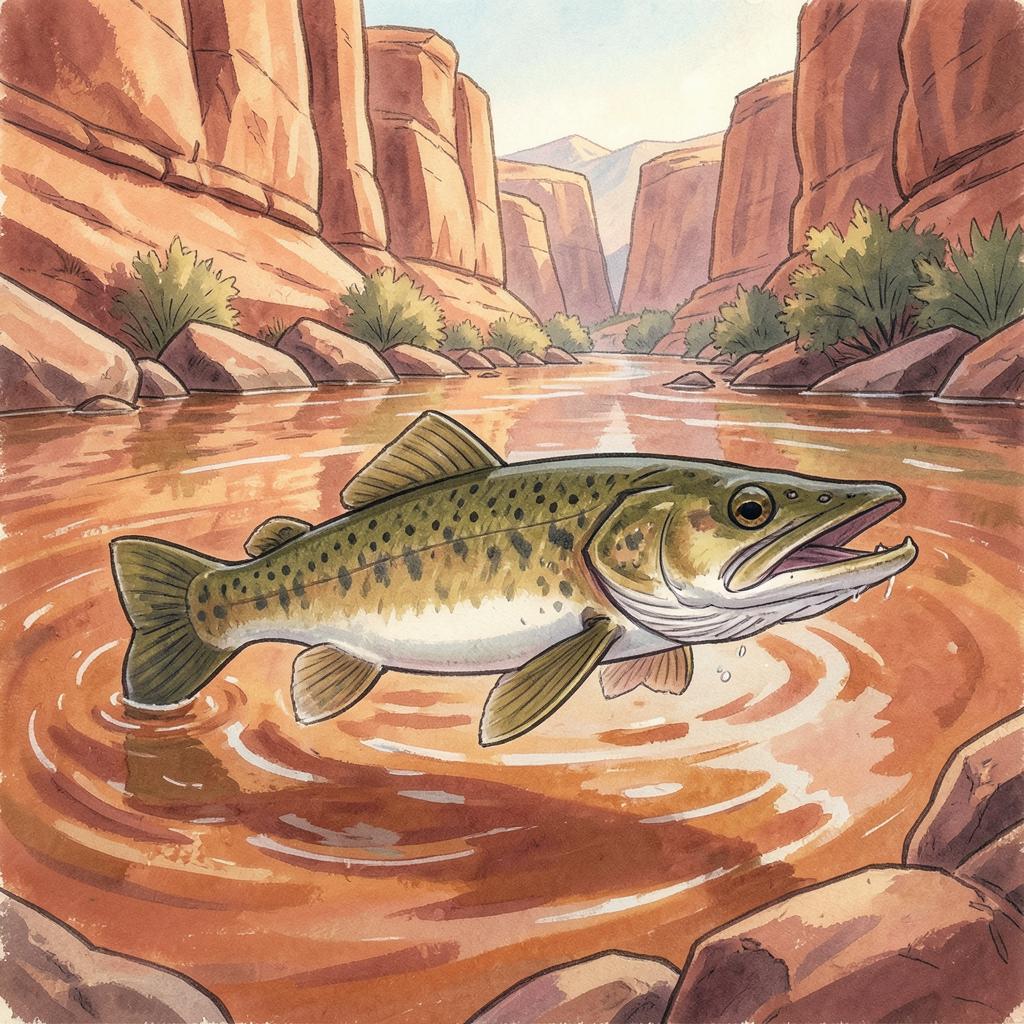
Illustrated Species Ambassador
Redwater — Colorado Pikeminnow
I'm Redwater, an illustrated ambassador for the Colorado pikeminnow. I am a minnow, though not the kind you picture: my kind once reached six feet.
- One fact worth knowing
- The Colorado pikeminnow is the largest minnow in North America. Historic fish reached about six feet; today it survives in remnant reaches of the Colorado River basin, and adults are far smaller.
- What I depend on
- I depend on long unobstructed river reaches for my spawning migration, natural spring flood pulses, and warm turbid backwaters where the young grow up.
- My greatest threat
- My greatest threats are dams and altered flow, together with non-native predatory fish.
- One way you can help
- Never move fish or bait between water bodies — non-native introductions are among the worst things that happen to this river.
This ambassador is an original illustration created for this project. It is an educational character, not a documentary image, and its statements follow the sourced record on this page. Artwork and rights record
Why this species matters
The pikeminnow evolved in a river of floods, silt, and warm water. Dams turned that river into a chain of cold, clear reservoirs, which suits introduced sport fish and not the natives. It is the clearest case of a river being changed so thoroughly that its own fish no longer fit it.
If it disappears: The Colorado basin would lose its largest native predator and one of four remaining endemic 'big river' fishes, leaving the system dominated by non-native species.
Conservation status
- IUCN Red List
- VulnerableLast verified 2026-09-08
- U.S. Endangered Species Act
- EndangeredListed 1967, with designated critical habitat.Last verified 2026-09-08
- Multiple states
- State endangered in Colorado, Utah, and elsewhere in the basinLast verified 2026-09-08
Population
Wild adults number in the low thousands in the upper basin, distributed among the Green, Yampa, White, and upper Colorado rivers; the San Juan River population is maintained by stocking.
Trend: Decreasing
As reported: Upper Colorado River Endangered Fish Recovery Program monitoring, 2010s–2020s
Source: U.S. Fish and Wildlife Service Upper Colorado River Endangered Fish Recovery Program
Uncertainty: Population estimates come from mark-recapture surveys in specific river reaches and are reported with confidence intervals.
Historical: Formerly abundant throughout the Colorado basin from Wyoming to Mexico, and caught commercially in the early twentieth century.
Fragmentation: Extirpated from the entire lower basin below Glen Canyon Dam.
Range and distribution
Historic range: The entire Colorado River basin from Wyoming to the Gulf of California.
Current range: The upper basin — Green, Yampa, White, upper Colorado, and San Juan rivers.
Range contraction: Absent from roughly the lower half of its historic basin.
Regions occupied
- Colorado
- Utah
- Wyoming
- New Mexico
Habitat
Primary habitat: Warm, turbid, seasonally fluctuating desert rivers with deep pools, eddies, and backwaters.
Breeding habitat: Migrates long distances — sometimes over 100 miles — to specific cobble-bar spawning reaches.
Feeding habitat: Preys on other fish in deep runs and pools.
Critical habitat: Critical habitat designated across upper basin rivers.
Habitat dependencies
- Long, unobstructed river reaches for spawning migration
- Natural spring flood pulses
- Warm, turbid water and flooded backwater nurseries
Biology and ecology
The apex native predator of the Colorado River system.
Important adaptations: Streamlined body adapted to strong current, and a tolerance for warm, silt-laden water that most fish cannot handle.
- Size
- Historically up to about 6 feet; today adults are typically far smaller.
- Weight
- Historically up to roughly 80 pounds.
- Lifespan
- Potentially over 40 years.
- Diet
- Fish, including native suckers and chubs; young eat invertebrates.
- Reproduction
- Long-distance migration to cobble spawning bars, with strong site fidelity.
- Offspring
- Tens of thousands of eggs per female.
- Breeding frequency
- Annually once mature, if flows allow.
- Age at maturity
- About 5–7 years.
Primary threats
Dams and barriers
Mainstem dams block spawning migrations and convert river to reservoir.
Altered streamflow
Flow regulation removes the spring floods that build spawning bars and flood nursery backwaters.
Cold water releases
Water released from the bottom of reservoirs is too cold for native fish to spawn or for young to grow.
Non-native species
Introduced smallmouth bass, northern pike, and channel catfish prey on young pikeminnow and compete with adults.
Water withdrawal
Basin-wide allocation leaves less water in the river than the native fish evolved with.
Habitat loss
Loss of flooded backwaters eliminates nursery habitat for juveniles.
Conservation and recovery
Programs and efforts
- Upper Colorado River Endangered Fish Recovery Program, a multi-state and federal partnership
- San Juan River Basin Recovery Implementation Program
- Non-native predator removal in critical reaches
- Fish passage construction around diversion dams
- Managed flow releases to mimic spring floods
- Hatchery propagation and stocking
Protected areas
- Dinosaur National Monument (Green and Yampa rivers)
- Canyonlands National Park
- Designated critical habitat across the upper basin
Legal protections
- Endangered Species Act
- Designated critical habitat
- State endangered listings
Measurable progress
- Fish passages have restored access to hundreds of miles of historic habitat
- The Yampa River, one of the last relatively free-flowing reaches, still supports natural reproduction
Continuing challenges
- Basin water is over-allocated
- Non-native predators are effectively permanent
- Prolonged drought is reducing flows further
How people can help
What individuals can do
- Never move fish or bait between water bodies — non-native introductions are a leading threat
- Report and release any native pikeminnow caught while fishing
- Conserve water in Colorado basin communities
What communities can do
- Support environmental flow agreements and fish passage projects
Educational actions
- Use historic photographs of six-foot pikeminnow to teach shifting baselines
Habitat support
- Back floodplain and backwater reconnection projects on upper basin rivers
Organizations and programs to learn about
- Upper Colorado River Endangered Fish Recovery Program
- USFWS Mountain-Prairie Region
- state wildlife agencies
Educational notes
- Nicknamed the 'Colorado salmon' for its long spawning migrations.
- An excellent illustration of shifting baselines: today's adults are a fraction of historic size.