Birds
California Condor
Gymnogyps californianus
North America's largest land bird, taken entirely into captivity in 1987 at 27 individuals and returned to the wild since 1992.
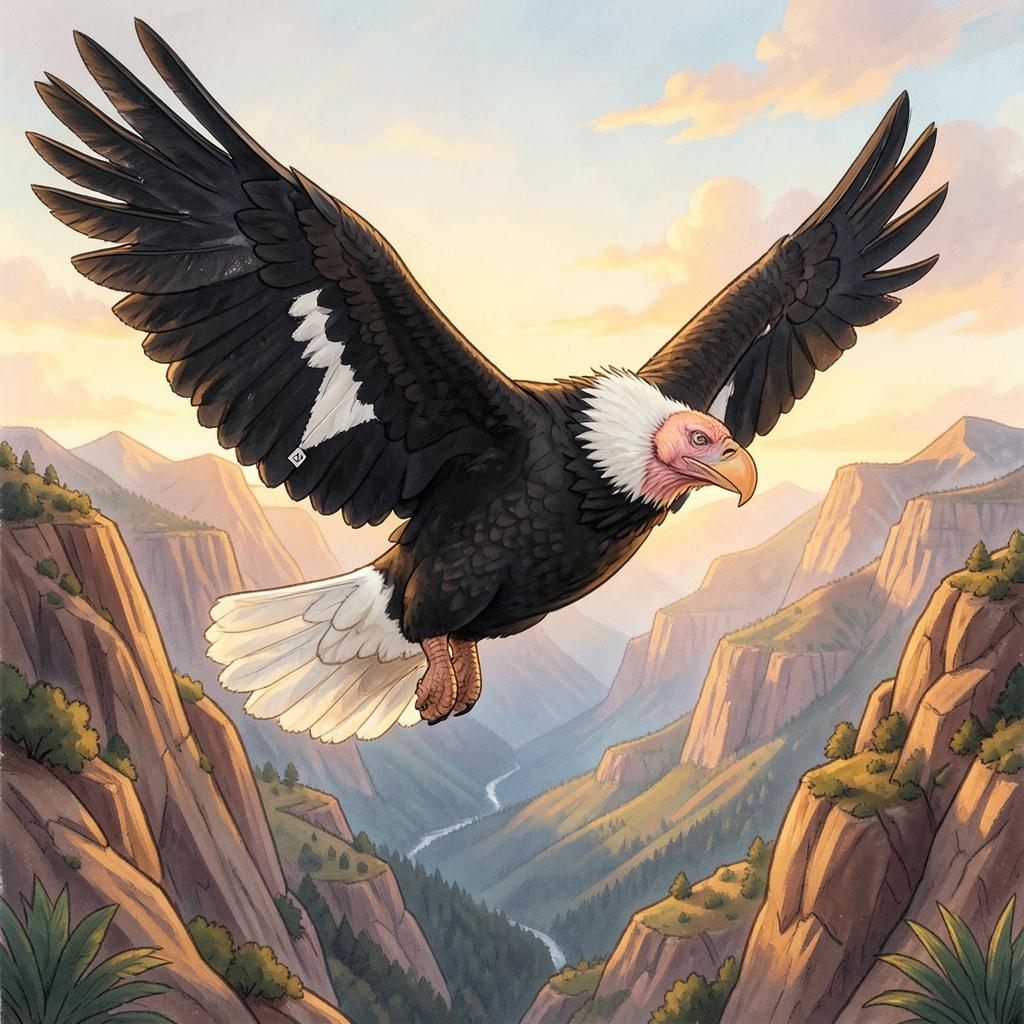
Illustrated Species Ambassador
Vela — California Condor
I'm Vela, an illustrated ambassador for the California condor. I ride the updrafts over canyon country, and I carry a numbered tag because every one of us is counted.
- One fact worth knowing
- By 1987 only 27 California condors were left and all of them were taken into captivity. Releases back into the wild began in 1992.
- What I depend on
- I depend on rugged mountain and canyon country with reliable updrafts, undisturbed cliff nest sites, and large carcasses to feed on.
- My greatest threat
- My greatest threat is lead poisoning from fragments of spent ammunition in the carcasses I eat.
- One way you can help
- Use non-lead ammunition anywhere in condor range, and pick up microtrash — bottle caps, wire, glass — at trailheads and in open country.
This ambassador is an original illustration created for this project. It is an educational character, not a documentary image, and its statements follow the sourced record on this page. Artwork and rights record
Why this species matters
The condor is the most expensive and intensively managed bird recovery in United States history, and it works only as long as people keep lead out of the carcasses condors eat. It is a direct test of whether society will change a routine practice to keep a species alive.
If it disappears: Extinction would remove North America's largest scavenger and end a recovery that has already demonstrated a captive-bred population can return to the wild.
Cultural and regional note: The condor holds deep significance for several Indigenous nations; the Yurok Tribe leads a condor release program in northern California.
Conservation status
- IUCN Red List
- Critically EndangeredLast verified 2026-09-08
- U.S. Endangered Species Act
- EndangeredListed 1967.Last verified 2026-09-08
- CITES
- Appendix ILast verified 2026-09-08
Population
Roughly 560 condors total, with more than half — approximately 340 — flying free in California, Arizona, Utah, and Baja California.
Trend: Increasing
As reported: USFWS California Condor Recovery Program annual population status, 2023–2024
Source: U.S. Fish and Wildlife Service California Condor Recovery Program
Uncertainty: USFWS publishes a status table each year separating wild and captive birds; totals shift with releases and mortality.
Historical: Reduced to 22–27 known individuals in the early 1980s; the last wild bird was captured in 1987.
Fragmentation: Wild birds occur in several separated release flocks that only partly mix.
Range and distribution
Historic range: Across much of North America during the Pleistocene; in recent centuries the Pacific coast from British Columbia to Baja California.
Current range: Central and southern California, the Arizona-Utah border region, Baja California, and a Yurok Tribe release site in northern California.
Range contraction: Occupies a small portion of even its recent historic range.
Regions occupied
- California
- Arizona
- Utah
- Baja California, Mexico
Habitat
Primary habitat: Rugged mountain, canyon, and coastal country with reliable updrafts.
Breeding habitat: Nests in cliff caves, rock crevices, and occasionally cavities in large old-growth trees.
Feeding habitat: Ranges enormous distances over open country searching for large carcasses.
Critical habitat: Critical habitat designated in southern California.
Habitat dependencies
- Large carrion supply free of lead ammunition fragments
- Undisturbed cliff nest sites
Biology and ecology
A scavenger that removes large carcasses, limiting disease spread and recycling nutrients.
Important adaptations: Bare head for hygienic feeding inside carcasses; soaring flight covering more than 100 miles a day.
- Size
- Wingspan up to about 9.5 feet.
- Weight
- Approximately 17–25 pounds.
- Lifespan
- Up to about 60 years.
- Diet
- Exclusively carrion — deer, cattle, marine mammals, and other large carcasses.
- Reproduction
- Nests in cliff caves; both parents share incubation and a long chick-rearing period.
- Offspring
- A single egg.
- Breeding frequency
- Typically one egg every other year because chick care lasts more than a year.
- Age at maturity
- Around 6–8 years.
Primary threats
Lead poisoning
Ingesting lead fragments from ammunition in carcasses and gut piles remains the leading cause of death and requires ongoing capture and chelation treatment.
Microtrash ingestion
Adults feed bottle caps, glass, and metal fragments to chicks, causing nestling deaths.
Disease
Highly pathogenic avian influenza killed a significant number of Arizona-Utah condors in 2023, prompting an emergency vaccination effort.
Collisions and electrocution
Power line strikes are a documented mortality source; released birds are trained to avoid poles.
Habitat loss
Development reduces open foraging country and disturbs nest sites.
Slow reproduction
One chick every other year makes population growth inherently slow.
Conservation and recovery
Programs and efforts
- USFWS California Condor Recovery Program
- Captive breeding at the San Diego Zoo Wildlife Alliance, Los Angeles Zoo, Oregon Zoo, and The Peregrine Fund
- Yurok Tribe Northern California Condor Restoration Program
- Non-lead ammunition outreach and free ammunition exchange programs
- Avian influenza vaccination of condors, first authorized in 2023
Protected areas
- Hopper Mountain, Bitter Creek, and Hopper Mountain NWR Complex
- Pinnacles National Park
- Grand Canyon National Park
- Los Padres National Forest
Legal protections
- Endangered Species Act
- Migratory Bird Treaty Act
- California non-lead ammunition requirement for hunting
Measurable progress
- Grew from 22 birds to more than 500
- Wild-hatched chicks now fledge annually in multiple flocks
- California banned lead ammunition for hunting statewide
Continuing challenges
- Lead exposure persists
- Population is not yet self-sustaining without management
- Avian influenza is a new and serious risk
How people can help
What individuals can do
- Use non-lead ammunition when hunting anywhere in condor range
- Remove microtrash — bottle caps, wire, glass — from open country and trailheads
- Never approach or feed a condor; report tagged birds by number
What communities can do
- Support non-lead ammunition exchange programs
- Back power line retrofits in condor foraging areas
Educational actions
- Follow the annual USFWS population status table as a public dataset
Habitat support
- Support open rangeland and cliff-nesting habitat protection
Organizations and programs to learn about
- USFWS California Condor Recovery Program
- The Peregrine Fund
- Yurok Tribe Wildlife Department
Educational notes
- Every wild condor carries a numbered wing tag, so individual life histories can be followed.
- Illustrates the difference between a species being alive and a species being self-sustaining.