Reptiles and Amphibians
American Crocodile
Crocodylus acutus
A coastal crocodile of mangrove estuaries whose Florida population recovered enough to be downlisted from endangered to threatened in 2007.
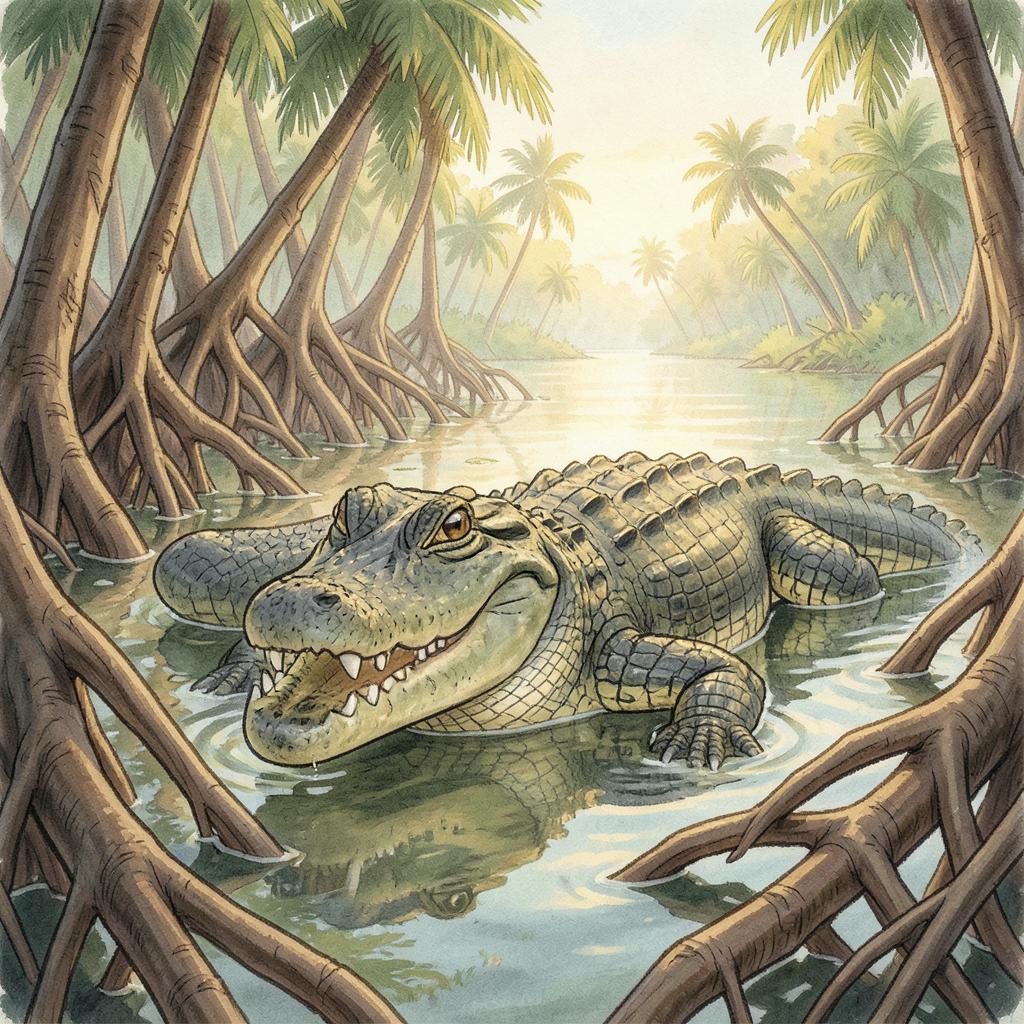
Illustrated Species Ambassador
Maree — American Crocodile
I'm Maree, an illustrated ambassador for the American crocodile. I am not the alligator you have heard stories about; I am the shy one in the mangroves.
- One fact worth knowing
- The Florida population of American crocodiles recovered well enough to be downlisted from endangered to threatened in 2007.
- What I depend on
- I depend on mangrove shoreline, undisturbed nesting banks, and the right balance of fresh and salt water in estuaries. When freshwater flow is altered, my nurseries go wrong.
- My greatest threat
- My greatest threat is coastal development together with altered freshwater flow through south Florida.
- One way you can help
- Never feed a crocodile or alligator — feeding is what turns a shy animal into a dangerous one — and report sightings to wildlife officials rather than moving the animal yourself.
This ambassador is an original illustration created for this project. It is an educational character, not a documentary image, and its statements follow the sourced record on this page. Artwork and rights record
Why this species matters
The American crocodile is one of the most successful and least publicized recoveries under U.S. endangered species law. It also shows that a large predator can share space with a dense human population when habitat and behavior are both managed.
If it disappears: Losing it would remove the top predator from south Florida's mangrove estuaries and reverse a recovery that has already succeeded.
Conservation status
- IUCN Red List
- VulnerableLast verified 2026-09-08
- U.S. Endangered Species Act
- Threatened (Florida distinct population segment)Listed as endangered in 1975 and reclassified to threatened in 2007 after documented recovery.Last verified 2026-09-08
- CITES
- Appendix I, with some populations on Appendix IILast verified 2026-09-08
- Florida
- State threatenedLast verified 2026-09-08
Population
Roughly 2,000 adults in south Florida, up from a few hundred in the 1970s. Range-wide numbers across the Caribbean and Latin America are not precisely known and vary widely by country.
Trend: Increasing
As reported: USFWS and Florida Fish and Wildlife Conservation Commission reporting, 2010s–2020s
Source: U.S. Fish and Wildlife Service; Florida Fish and Wildlife Conservation Commission; IUCN Crocodile Specialist Group
Uncertainty: The Florida population is well monitored; several Latin American populations are poorly surveyed and their status is uncertain.
Historical: The Florida population fell to an estimated 100–400 adults by the 1970s.
Range and distribution
Historic range: Coastal mangrove and estuary habitat from south Florida through the Caribbean, Mexico, Central America, and northern South America.
Current range: Same range; recovering in Florida, variable elsewhere.
Range contraction: Extirpated from some Caribbean and Latin American localities through hunting and development.
Regions occupied
- South Florida
- Cuba, Jamaica, Hispaniola
- Mexico
- Central America
- Colombia
- Venezuela
- Ecuador
- Peru
Habitat
Primary habitat: Brackish and saltwater coastal habitats: mangrove swamps, estuaries, lagoons, and tidal creeks.
Breeding habitat: Nests in sandy or marl mounds and beaches above the tide line.
Feeding habitat: Hunts fish, crabs, turtles, and birds in shallow coastal water.
Critical habitat: Critical habitat designated in south Florida.
Habitat dependencies
- Mangrove shoreline
- Suitable freshwater and saltwater balance in estuaries
- Undisturbed nesting banks
Biology and ecology
Apex estuarine predator; nesting and wallowing activity creates habitat features other species use.
Important adaptations: Salt glands on the tongue excrete excess salt, allowing it to live in fully marine conditions — unlike the American alligator.
- Size
- Commonly 10–15 feet; large males can exceed that.
- Weight
- Often 400–900 pounds for large adults.
- Lifespan
- Estimated 50–70 years.
- Diet
- Fish, crabs, turtles, birds, and small mammals.
- Reproduction
- Females build mound or hole nests and guard them; hatchlings call from inside the nest and are assisted to water.
- Offspring
- Typically 30–60 eggs.
- Breeding frequency
- One clutch a year.
- Age at maturity
- Around 10–15 years.
Primary threats
Habitat loss
Coastal development and mangrove removal eliminate nesting and nursery habitat.
Altered freshwater flow
Everglades water management changes estuary salinity, which affects hatchling survival.
Road mortality
Crocodiles moving between water bodies are struck on south Florida roads.
Human-wildlife conflict
Nuisance removals and illegal killing occur as crocodiles appear in canals and neighborhoods.
Sea-level rise
Rising seas and storm surge inundate low nesting sites.
Illegal hunting
Hide hunting and killing remain issues in parts of the Latin American range.
Conservation and recovery
Programs and efforts
- USFWS and FWC crocodile monitoring and nest surveys in south Florida
- Comprehensive Everglades Restoration Plan freshwater flow restoration
- Crocodile response and relocation protocols instead of lethal removal
- IUCN Crocodile Specialist Group range-wide coordination
Protected areas
- Everglades National Park
- Crocodile Lake National Wildlife Refuge
- Biscayne National Park
- Turkey Point cooling canals, which host a substantial nesting population
Legal protections
- Endangered Species Act (threatened)
- CITES Appendix I
- Florida state protection
Measurable progress
- Florida population increased roughly fivefold and was downlisted in 2007
- Nesting expanded into new areas including managed industrial canal systems
Continuing challenges
- Sea-level rise threatens nesting habitat
- Human encounters increase as both populations grow
- Range-wide status outside Florida is poorly documented
How people can help
What individuals can do
- Never feed a crocodile or alligator — feeding is what turns a shy animal into a dangerous one
- Keep pets leashed and away from canal and mangrove edges
- Report crocodile sightings to FWC rather than attempting to move the animal
What communities can do
- Support Everglades freshwater restoration
- Back mangrove shoreline protection and living shorelines
Educational actions
- Teach the difference between the shy American crocodile and the American alligator
Habitat support
- Support mangrove planting and estuary restoration in south Florida
Organizations and programs to learn about
- USFWS Crocodile Lake National Wildlife Refuge
- Florida Fish and Wildlife Conservation Commission
- IUCN Crocodile Specialist Group
Educational notes
- A quiet success story that rarely gets attention compared with more charismatic recoveries.
- Salt glands make it a good example of physiological adaptation to a habitat boundary.