Fish and Aquatic Life
Smalltooth Sawfish
Pristis pectinata
A shark-like ray with a toothed rostrum, the first marine fish ever listed under the U.S. Endangered Species Act.
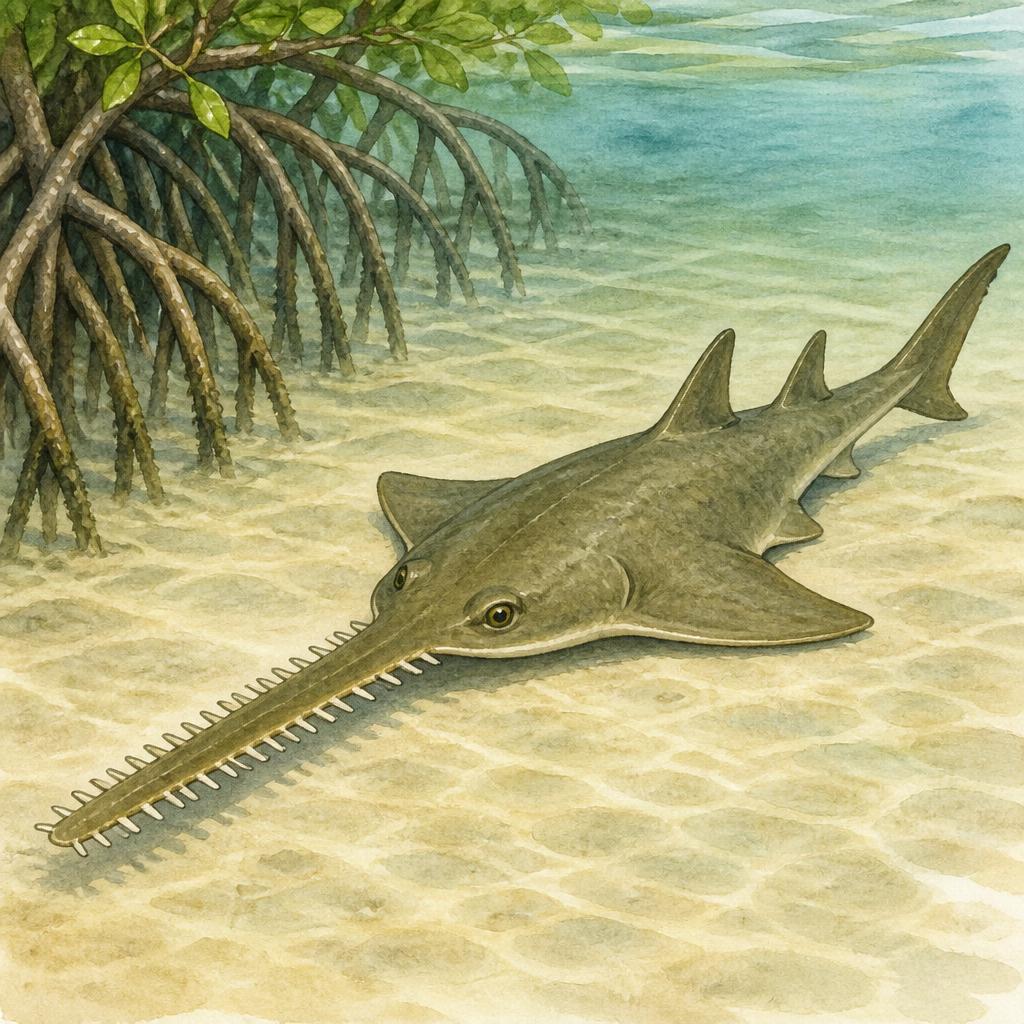
Illustrated Species Ambassador
Prista — Smalltooth Sawfish
I'm Prista, an illustrated ambassador for the smalltooth sawfish. The saw on my face is a hunting and sensing tool, not a weapon against people.
- One fact worth knowing
- The smalltooth sawfish was the first marine fish ever listed under the U.S. Endangered Species Act.
- What I depend on
- I depend on shallow, warm estuaries and bays, and especially on red mangrove shorelines where young sawfish grow up.
- My greatest threat
- My greatest threat is entanglement in fishing nets and lines, together with the loss of mangrove shoreline.
- One way you can help
- If you hook a sawfish, keep it in the water and cut the line close to the hook, then report the encounter to the national sawfish hotline — angler reports are the main monitoring dataset.
This ambassador is an original illustration created for this project. It is an educational character, not a documentary image, and its statements follow the sourced record on this page. Artwork and rights record
Why this species matters
The very adaptation that makes a sawfish successful — its saw — is what dooms it in a net. It shows how a single fishing gear type can eliminate a species across an ocean basin, and how quickly a protected population can begin to recover.
If it disappears: Losing it would remove a top predator from Florida's estuaries and eliminate one of only a handful of surviving sawfish species worldwide.
Conservation status
- IUCN Red List
- Critically EndangeredLast verified 2026-09-08
- U.S. Endangered Species Act
- EndangeredThe U.S. distinct population segment was listed in 2003 — the first marine fish listed under the ESA.Last verified 2026-09-08
- CITES
- Appendix ILast verified 2026-09-08
Population
The U.S. population is estimated in the low thousands, concentrated in south Florida. Globally the species has been lost from most of its historic range, with a documented decline exceeding 95 percent.
Trend: Increasing
As reported: NOAA Fisheries recovery status reporting, 2010s–2020s
Source: NOAA Fisheries; IUCN Red List
Uncertainty: The U.S. population appears to be slowly increasing under protection, while the global population continues to decline. Do not describe the trend as uniform.
Historical: Formerly ranged from Texas to North Carolina and throughout the Caribbean and western Atlantic.
Fragmentation: The U.S. population is essentially confined to south Florida.
Range and distribution
Historic range: Warm coastal waters of the western Atlantic from Texas to North Carolina, the Caribbean, and West Africa.
Current range: Primarily southwest Florida and the Florida Keys, with occasional records elsewhere in the Gulf.
Range contraction: Extirpated from most of the Gulf of Mexico and southeastern Atlantic coast.
Regions occupied
- South Florida
- Florida Keys
- Bahamas
- Scattered western Atlantic and West African records
Habitat
Primary habitat: Shallow coastal waters, estuaries, and bays with mangrove shoreline.
Breeding habitat: Gives birth in shallow estuarine nursery areas.
Feeding habitat: Uses its rostrum to detect and stun fish over shallow bottom.
Critical habitat: Critical habitat designated in southwest Florida, including the Charlotte Harbor and Ten Thousand Islands nursery areas.
Habitat dependencies
- Red mangrove shoreline nursery habitat
- Shallow, warm estuarine water
- Low entanglement risk from nets and lines
Biology and ecology
A large estuarine predator structuring shallow-water fish communities.
Important adaptations: The toothed rostrum, called a saw, carries electroreceptors that detect prey in murky water and is swept sideways to stun fish — the same structure that makes the animal fatally prone to tangling in nets.
- Size
- Up to about 16 feet including the rostrum.
- Weight
- Several hundred pounds for large adults.
- Lifespan
- Estimated 30 years or more.
- Diet
- Fish, shrimp, and crabs.
- Reproduction
- Ovoviviparous — gives birth to live young after roughly a year of gestation.
- Offspring
- Typically 7–14 pups.
- Breeding frequency
- Females reproduce roughly every two years.
- Age at maturity
- Around 10 years.
Primary threats
Bycatch
The rostrum entangles in gillnets, trawls, and lines; historically this was the principal cause of decline.
Habitat loss
Mangrove removal and coastal development destroy the shallow nursery habitat pups depend on.
Illegal collection
Rostra are sold as curios and were historically taken as trophies.
Water quality
Harmful algal blooms and altered freshwater flow degrade estuarine nursery habitat.
Slow reproduction
Late maturity and small litters make recovery inherently slow.
Unexplained mortality events
A sawfish mortality and abnormal-behavior event in the Florida Keys beginning in 2023 killed dozens of sawfish; investigation into the cause is ongoing.
Conservation and recovery
Programs and efforts
- NOAA Fisheries Smalltooth Sawfish Recovery Plan
- Designated critical habitat in southwest Florida
- Sawfish encounter reporting hotline and safe-release outreach to anglers
- Emergency response and rescue effort during the Florida Keys mortality event
- Mangrove restoration in nursery estuaries
Protected areas
- Everglades National Park
- Ten Thousand Islands National Wildlife Refuge
- Charlotte Harbor estuary
- Florida Keys National Marine Sanctuary
Legal protections
- Endangered Species Act
- CITES Appendix I
- Florida prohibition on harvest since 1992
Measurable progress
- The U.S. population is one of the few sawfish populations anywhere showing signs of increase
- Angler reporting has produced a valuable long-term encounter dataset
Continuing challenges
- The 2023–2024 mortality event is unexplained
- Global populations continue to decline
- Recovery is slow because of late maturity
How people can help
What individuals can do
- If you hook a sawfish, keep it in the water, cut the line close to the hook, and never remove it from the water
- Report every sawfish encounter to the national sawfish hotline — angler reports are the primary monitoring dataset
- Never buy a sawfish rostrum
What communities can do
- Support mangrove protection and restoration in estuaries
- Back water quality improvements that reduce algal blooms
Educational actions
- Use the rostrum to teach how a specialized adaptation can become a liability under new pressures
Habitat support
- Volunteer for mangrove planting in southwest Florida
Organizations and programs to learn about
- NOAA Fisheries Southeast Region
- Florida Fish and Wildlife Conservation Commission
- Havenworth Coastal Conservation sawfish research
Educational notes
- The first marine fish ever protected under the U.S. Endangered Species Act.
- Angler-reported encounters are the primary scientific dataset — a real citizen-science success.
Sources and references
- IUCN Red List — Pristis pectinata — IUCN
- NOAA Fisheries — Smalltooth Sawfish — NOAA Fisheries
- CITES Appendices — CITES