Marine Life
Elkhorn Coral
Acropora palmata
Once the dominant reef-building coral of the shallow Caribbean, reduced by disease and bleaching to a fraction of its former cover.
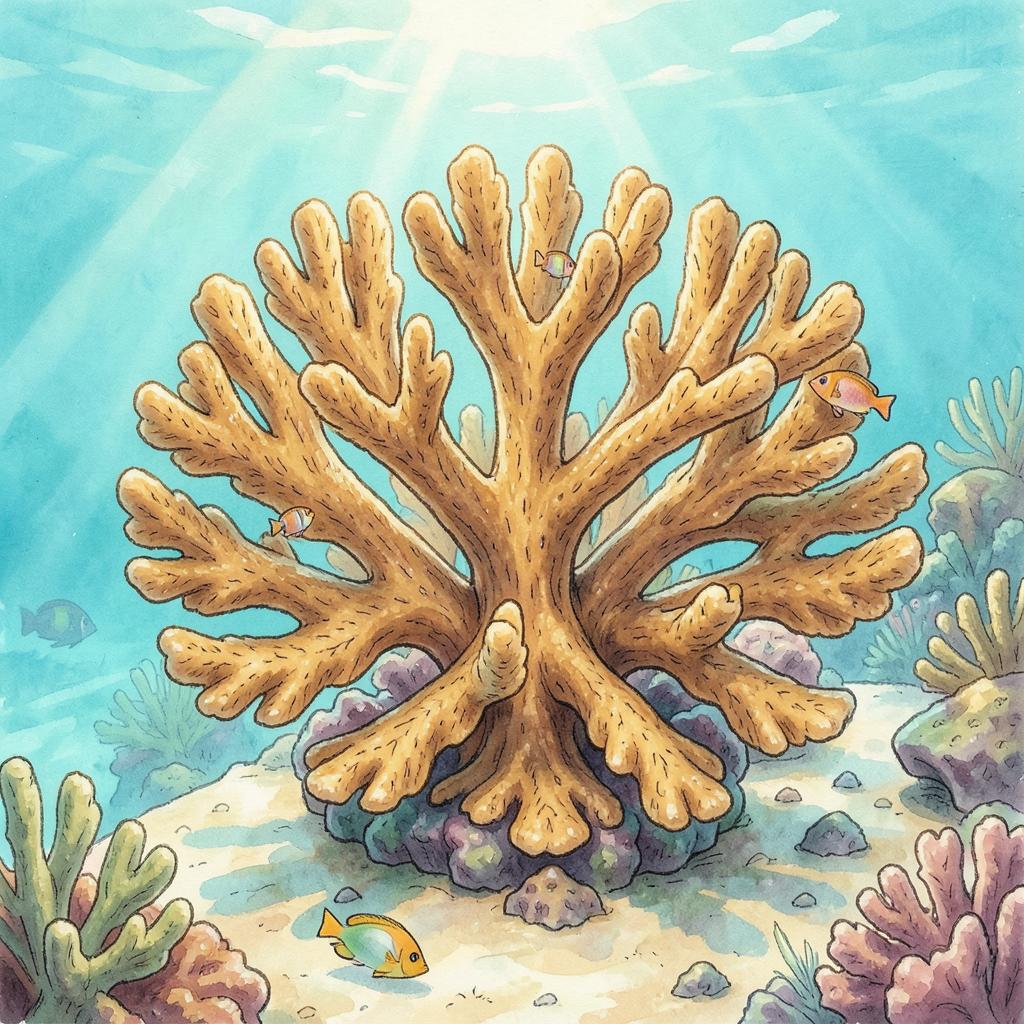
Illustrated Species Ambassador
Palma — Elkhorn Coral
Welcome. I'm Palma, an illustrated ambassador for elkhorn coral. I am an animal, though I look like a tree, and I built the shallow Caribbean reef you are swimming over.
- One fact worth knowing
- Elkhorn coral was once the dominant reef-building coral of the shallow Caribbean and has been reduced by disease and bleaching to a fraction of its former cover.
- What I depend on
- I depend on the tiny algae living inside me, on clear low-nutrient water with strong light, and on sea temperatures staying below the level that makes me expel those algae.
- My greatest threat
- My greatest threats are disease and ocean warming.
- One way you can help
- Never touch, stand on, or anchor on coral, and use mineral sunscreen without oxybenzone or octinoxate when you swim on a reef.
This ambassador is an original illustration created for this project. It is an educational character, not a documentary image, and its statements follow the sourced record on this page. Artwork and rights record
Why this species matters
Elkhorn coral is infrastructure. Its branching thickets absorb wave energy before it reaches shore, protecting beaches and coastal communities. Rebuilding it is coastal protection as much as wildlife conservation.
If it disappears: Caribbean reef crests would lose their principal builder, coastal wave protection would weaken measurably, and reef fish would lose critical shelter.
Conservation status
- IUCN Red List
- Critically EndangeredLast verified 2026-09-08
- U.S. Endangered Species Act
- ThreatenedListed 2006, with designated critical habitat; a status revision has been under consideration.Last verified 2026-09-08
- CITES
- Appendix II (all stony corals)Last verified 2026-09-08
Population
Populations have declined by an estimated 80 percent or more since the 1980s across the Caribbean, with severe additional losses in Florida following the 2014 stony coral tissue loss disease outbreak and the 2023 marine heatwave.
Trend: Decreasing
As reported: NOAA Fisheries status review and Caribbean reef monitoring programs
Source: NOAA Fisheries; IUCN Red List; Florida Keys reef monitoring
Uncertainty: Coral abundance is reported as percent living cover or colony counts, not as individual organisms. A coral 'colony' is many genetically identical polyps.
Historical: Formed dense, wave-resistant thickets across shallow Caribbean reef crests, historically the defining structure of that zone.
Fragmentation: Surviving colonies are scattered and often too far apart for successful sexual reproduction.
Range and distribution
Historic range: Shallow reef crests throughout the Caribbean, the Bahamas, and the Florida reef tract.
Current range: The same geographic range at greatly reduced density, with local extirpations.
Range contraction: Functional loss of the reef crest thickets it once formed.
Regions occupied
- Florida Keys and southeast Florida
- Bahamas
- Greater and Lesser Antilles
- Caribbean coast of Central and South America
Habitat
Primary habitat: Shallow, high-energy reef crest and fore-reef in clear water, typically less than 20 feet deep.
Breeding habitat: Spawns once a year in a synchronized mass spawning event a few nights after the August full moon.
Feeding habitat: Obtains most energy from symbiotic algae living in its tissue, supplemented by capturing plankton.
Critical habitat: Critical habitat designated in Florida, Puerto Rico, and the U.S. Virgin Islands.
Habitat dependencies
- Symbiotic zooxanthellae algae, which are expelled during heat stress
- Clear, low-nutrient water with strong light
- Sea temperatures below the bleaching threshold
Biology and ecology
The primary reef-crest builder of the Caribbean. Its branching structure absorbs wave energy, protecting shorelines, and shelters a large share of reef fish and invertebrates.
Important adaptations: Rapid growth — among the fastest-growing Caribbean corals — and thick, wave-resistant branches suited to the surf zone.
- Size
- Colonies can exceed 12 feet across.
- Lifespan
- Colonies can persist for decades to centuries.
- Diet
- Sugars produced by symbiotic algae, plus captured plankton.
- Reproduction
- Reproduces both sexually, through annual synchronized mass spawning, and asexually, when broken branches reattach and grow — a fast strategy that produces genetically identical colonies.
- Offspring
- Millions of gametes released in a single spawning night, with very low survival.
- Breeding frequency
- Once yearly.
Primary threats
Disease
White band disease drove the initial collapse in the 1970s and 1980s. Stony coral tissue loss disease, first observed off Florida in 2014, has since spread across much of the Caribbean.
Ocean warming
Heat stress causes corals to expel their symbiotic algae and bleach. The 2023 Florida marine heatwave produced water temperatures that killed corals outright, including restoration outplants.
Ocean acidification
Falling ocean pH makes it harder for corals to build calcium carbonate skeletons.
Water quality
Nutrient runoff and sedimentation from land promote algal overgrowth and disease.
Physical damage
Vessel groundings, anchors, and hurricanes break colonies.
Loss of grazers
The Caribbean-wide die-off of the long-spined sea urchin removed a key algae grazer, allowing algae to smother coral recruits.
Reproductive failure
Colonies are now so scattered that spawning gametes often fail to meet.
Conservation and recovery
Programs and efforts
- Coral nursery and outplanting programs across Florida and the Caribbean, including Mission: Iconic Reefs
- Assisted gene flow and selective breeding for heat-tolerant genotypes
- Emergency removal of nursery corals to land-based tanks during the 2023 heatwave
- Coral gene banking and cryopreservation of gametes
- Stony coral tissue loss disease treatment with antibiotic paste applied by divers
- Long-spined sea urchin restoration to restore grazing
Protected areas
- Florida Keys National Marine Sanctuary
- Biscayne National Park
- Buck Island Reef National Monument
- Designated critical habitat
Legal protections
- Endangered Species Act
- CITES Appendix II
- Marine sanctuary and park protections
- Anchoring restrictions on reefs
Measurable progress
- Nursery propagation has produced very large numbers of outplanted colonies
- Some outplanted colonies have survived heat events and spawned
- Heat-tolerant genotypes have been identified and propagated
Continuing challenges
- Restoration cannot outpace repeated marine heatwaves
- Disease spreads faster than treatment can be applied
- The underlying driver is global ocean temperature
How people can help
What individuals can do
- Use mineral sunscreen without oxybenzone or octinoxate when swimming on reefs
- Never touch, stand on, or anchor on coral
- Reduce fertilizer use in coastal watersheds
- Support coral restoration organizations directly
What communities can do
- Install and use mooring buoys instead of anchoring
- Improve wastewater treatment and stormwater management in coastal towns
Educational actions
- Use coral spawning as a teaching moment — it happens on predictable nights and is documented by researchers each year
Habitat support
- Volunteer with coral nursery and outplanting programs where certified
Organizations and programs to learn about
- NOAA Coral Reef Conservation Program
- Coral Restoration Foundation
- Mote Marine Laboratory
- Florida Keys National Marine Sanctuary
Educational notes
- Corals are animals, not plants, though they depend on algae living inside their tissue.
- Mass spawning happens on a few predictable nights each August.
- Reef crests function as natural breakwaters; losing them raises coastal flood risk.
Sources and references
- IUCN Red List — Acropora palmata — IUCN
- NOAA Fisheries — Elkhorn Coral — NOAA Fisheries
- Florida Keys National Marine Sanctuary — Mission: Iconic Reefs — NOAA