Fish and Aquatic Life
Atlantic Sturgeon
Acipenser oxyrinchus oxyrinchus
An armored fish little changed for over 100 million years, nearly wiped out by the nineteenth-century caviar boom and still blocked from most spawning rivers.
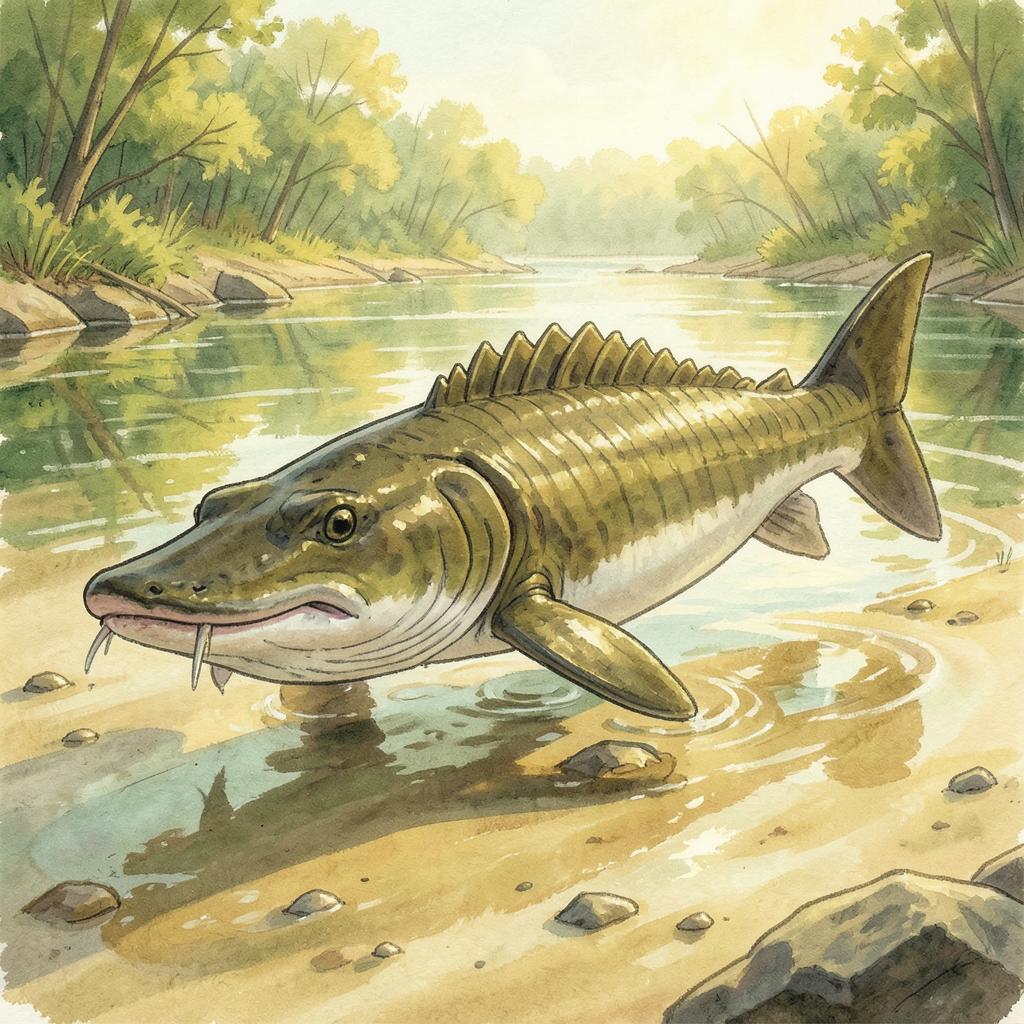
Illustrated Species Ambassador
Bastion — Atlantic Sturgeon
I am Bastion, an illustrated ambassador for the Atlantic sturgeon. My kind has changed very little in over a hundred million years. The last two centuries were harder than all of them.
- One fact worth knowing
- Atlantic sturgeon were nearly wiped out by the nineteenth-century caviar boom, and are still shut out of most of the rivers where they used to spawn.
- What I depend on
- I live in coastal ocean and estuary water and travel up large coastal rivers to spawn. I need clean hard-bottom spawning ground and enough oxygen in the estuary nurseries.
- My greatest threat
- My greatest threats are dams, bycatch in fishing gear, and vessel strikes.
- One way you can help
- If you catch a sturgeon by accident, release it at once without lifting it by the tail, and observe no-wake and speed rules in sturgeon rivers.
This ambassador is an original illustration created for this project. It is an educational character, not a documentary image, and its statements follow the sourced record on this page. Artwork and rights record
Why this species matters
A fish that takes twenty years to reproduce cannot absorb heavy fishing or a blocked river. Atlantic sturgeon show why life-history speed, not just population size, determines how fragile a species is.
If it disappears: Losing sturgeon runs would sever a nutrient link between the Atlantic and its rivers and end a lineage that predates most modern fish families.
Cultural and regional note: Sturgeon supported major colonial-era and nineteenth-century fisheries; the collapse of the Delaware caviar industry is a documented case of a fishery destroying itself.
Conservation status
- U.S. Endangered Species Act
- Endangered (New York Bight, Chesapeake Bay, Carolina, and South Atlantic distinct population segments); Threatened (Gulf of Maine)Listed in 2012 by NOAA Fisheries as five distinct population segments.Last verified 2026-09-08
- IUCN Red List
- Near Threatened (Acipenser oxyrinchus)Last verified 2026-09-08
- CITES
- Appendix IILast verified 2026-09-08
Population
Spawning runs are small and river-specific, with several rivers supporting only a few hundred spawning adults per year and some historic runs producing no documented spawning at all.
Trend: Unknown
As reported: NOAA Fisheries five-year review and river-specific spawning surveys, 2010s–2020s
Source: NOAA Fisheries; Atlantic States Marine Fisheries Commission
Uncertainty: There is no reliable coastwide total. Estimates are made river by river, and methods differ between rivers.
Historical: Nineteenth-century commercial landings ran to millions of pounds a year; the Delaware River alone supported a caviar industry that collapsed within decades.
Fragmentation: Populations are structured by natal river; fish return to spawn where they hatched, so a lost run does not naturally recolonize.
Range and distribution
Historic range: Coastal rivers from Labrador to Florida, ascending far upstream to spawn.
Current range: Roughly 35 rivers still support spawning, well below the historic number.
Migration: Anadromous — adults live in coastal ocean waters and ascend rivers to spawn in fresh water.
Range contraction: Spawning lost from many historic rivers due to dams and pollution.
Regions occupied
- Gulf of Maine
- New York Bight
- Chesapeake Bay
- Carolina and South Atlantic rivers
Habitat
Primary habitat: Coastal ocean and estuarine waters as adults; large coastal rivers for spawning.
Breeding habitat: Spawns over hard bottom — cobble, gravel, and bedrock — in flowing fresh water well upstream.
Feeding habitat: Bottom-feeds on worms, crustaceans, and mollusks in estuaries and shelf waters.
Critical habitat: Critical habitat designated in numerous Atlantic coast rivers.
Habitat dependencies
- Unobstructed access to upstream spawning reaches
- Clean hard-bottom spawning substrate
- Adequate dissolved oxygen in estuarine nursery areas
Biology and ecology
A large, long-lived benthic predator that moves nutrients between ocean and river systems.
Important adaptations: Bony external scutes instead of scales, and sensory barbels for detecting prey in sediment.
- Size
- Up to about 14 feet.
- Weight
- Up to roughly 800 pounds.
- Lifespan
- Up to about 60 years.
- Diet
- Benthic invertebrates — worms, crustaceans, mollusks — and small fish.
- Reproduction
- Broadcast spawning over hard bottom in flowing fresh water.
- Offspring
- Females release hundreds of thousands to millions of eggs.
- Breeding frequency
- Females spawn only every two to five years.
- Age at maturity
- Females often not until 15–20 years old.
Primary threats
Dams and barriers
Dams block access to historic upstream spawning reaches in most Atlantic rivers.
Bycatch
Incidental capture in gillnet and trawl fisheries remains a leading source of adult mortality.
Vessel strikes
Ship propeller strikes kill large adults in busy river channels, particularly the Delaware and James.
Water quality
Low dissolved oxygen in estuarine nursery habitat kills juveniles.
Dredging
Channel dredging destroys hard-bottom spawning habitat and can entrain fish directly.
Overharvest (historic)
The caviar boom removed most spawning adults before conservation measures existed.
Climate change
Warming water reduces oxygen in estuaries and shifts spawning cues.
Conservation and recovery
Programs and efforts
- NOAA Fisheries recovery planning for all five distinct population segments
- Coastwide moratorium on Atlantic sturgeon fishing since 1998
- Dam removal and fish passage projects on Atlantic coast rivers
- Vessel speed and dredging window restrictions in spawning rivers
Protected areas
- Designated critical habitat in Atlantic coast rivers
- National estuarine research reserves along the coast
Legal protections
- Endangered Species Act
- Atlantic States Marine Fisheries Commission fishing moratorium
- CITES Appendix II
Measurable progress
- Spawning has been documented in rivers where it was thought lost, including after dam removals
- The Penobscot River restoration reopened substantial habitat
Continuing challenges
- Recovery is measured in decades because of late maturity
- Bycatch is difficult to eliminate
- Many rivers remain dammed
How people can help
What individuals can do
- Report any sturgeon caught incidentally and release it immediately without lifting it by the tail
- Observe no-wake and speed rules in known sturgeon rivers
What communities can do
- Support dam removal and fish passage projects
- Back stormwater and nutrient reduction to raise estuary oxygen levels
Educational actions
- Use sturgeon to teach how age at maturity governs a species' resilience
Habitat support
- Support riparian restoration and sediment control in coastal river watersheds
Organizations and programs to learn about
- NOAA Fisheries
- Atlantic States Marine Fisheries Commission
- state river restoration partnerships
Educational notes
- Sturgeon are among the oldest surviving fish lineages, largely unchanged for over 100 million years.
- A clear historical example of a fishery collapsing within a single human generation.
Sources and references
- NOAA Fisheries — Atlantic Sturgeon — NOAA Fisheries
- IUCN Red List — Acipenser oxyrinchus — IUCN
- CITES Appendices — CITES