Fish and Aquatic Life
Atlantic Salmon (Gulf of Maine population)
Salmo salar
Once running in every large river in New England, the last wild U.S. Atlantic salmon return to a handful of Maine rivers in the hundreds.
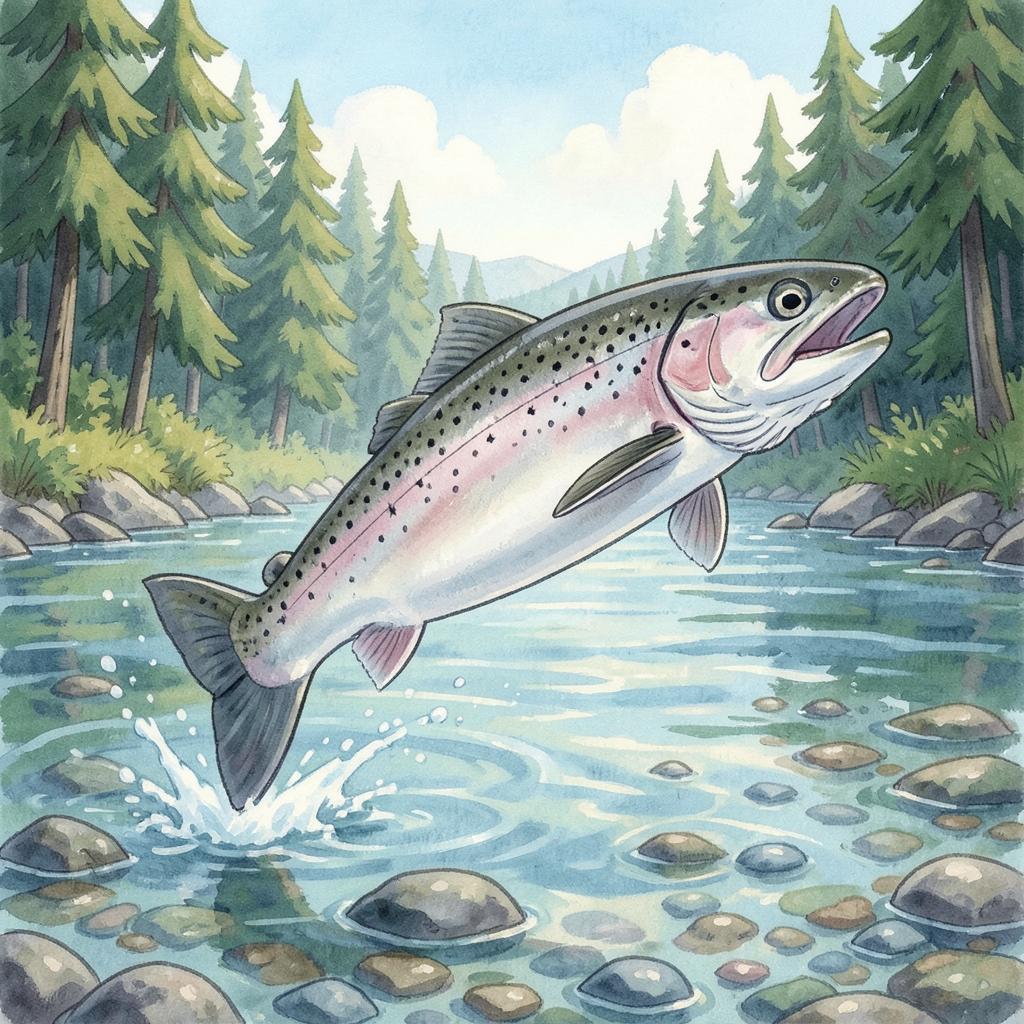
Illustrated Species Ambassador
Kennebec — Atlantic Salmon (Gulf of Maine population)
I'm Kennebec, an illustrated ambassador for the Atlantic salmon. I was born in a Maine river, grew up in the North Atlantic, and I am trying to come home.
- One fact worth knowing
- Atlantic salmon once ran up every large river in New England. The last wild United States population now returns to a handful of Maine rivers in the hundreds.
- What I depend on
- As a young fish I need cool, clean, gravel-bottomed river; as an adult I need the open ocean; and I need passage in both directions to get between them.
- My greatest threat
- My greatest threat is dams blocking access to the spawning habitat upstream.
- One way you can help
- Support dam removal and fish passage projects on New England rivers, and keep riverside forest buffers in place so the water stays cool.
This ambassador is an original illustration created for this project. It is an educational character, not a documentary image, and its statements follow the sourced record on this page. Artwork and rights record
Why this species matters
Salmon carry ocean nutrients upriver into forests and streams. Their loss impoverishes freshwater systems far inland, and their recovery has become the anchor for the largest river restoration project in the eastern United States.
If it disappears: The United States would lose its last native Atlantic salmon runs, and Maine rivers would lose a keystone nutrient pathway from ocean to headwaters.
Cultural and regional note: Atlantic salmon hold cultural and treaty significance for the Penobscot Nation and other Wabanaki peoples, who have been central partners in Penobscot River restoration.
Conservation status
- U.S. Endangered Species Act
- Endangered (Gulf of Maine distinct population segment)Listed in 2000 and expanded in 2009; jointly managed by NOAA Fisheries and USFWS.Last verified 2026-09-08
- IUCN Red List
- Near Threatened (Salmo salar, global assessment)The species was reassessed in 2023.Last verified 2026-09-08
- Maine
- State endangeredLast verified 2026-09-08
Population
Adult returns to Maine rivers typically number in the hundreds to low thousands per year, with the Penobscot River accounting for the large majority. Most returning fish originate from hatchery stocking rather than wild spawning.
Trend: Decreasing
As reported: NOAA Fisheries and Maine Department of Marine Resources annual trap counts
Source: NOAA Fisheries; Maine Department of Marine Resources
Uncertainty: Counts come from fish traps at dams and are reasonably accurate, but the wild-origin share is much smaller than the total.
Historical: Historic runs numbered in the hundreds of thousands across New England rivers from Long Island Sound to Maine.
Fragmentation: Confined to a small number of Maine rivers; runs in southern New England were lost entirely.
Range and distribution
Historic range: Rivers from Long Island Sound north through Maine and Atlantic Canada, and across the North Atlantic to Europe.
Current range: In the United States, roughly a dozen Maine rivers, principally the Penobscot, Kennebec, and Narraguagus.
Migration: Anadromous — juveniles migrate to sea, feed for one to three years off Greenland, and return to their natal river to spawn.
Range contraction: Extirpated from all U.S. rivers south of Maine.
Regions occupied
- Maine
- Gulf of Maine
- North Atlantic feeding grounds near Greenland
Habitat
Primary habitat: Cool, clean, gravel-bottomed rivers as juveniles; the open North Atlantic as adults.
Breeding habitat: Spawns in gravel redds in fast, oxygenated riffles.
Feeding habitat: Insects as juveniles; capelin, sand lance, and crustaceans at sea.
Critical habitat: Extensive critical habitat designated across Maine river systems.
Habitat dependencies
- Unobstructed upstream and downstream passage
- Cool water temperature
- Clean gravel spawning substrate
- Ocean prey availability
Biology and ecology
Transports marine-derived nutrients into freshwater ecosystems and supports predators from eagles to seals.
Important adaptations: Homing to natal rivers using olfactory memory and magnetic orientation.
- Size
- Commonly 28–30 inches on return.
- Weight
- Typically 8–12 pounds, sometimes much larger.
- Lifespan
- Around 4–6 years.
- Diet
- Aquatic insects in fresh water; fish and crustaceans at sea.
- Reproduction
- Digs gravel nests called redds; unlike Pacific salmon, some adults survive spawning and return to sea.
- Offspring
- Several thousand eggs per female.
- Breeding frequency
- Usually once, though repeat spawners occur.
- Age at maturity
- After one to three years at sea.
Primary threats
Dams and barriers
Dams block access to spawning habitat and kill smolts passing downstream through turbines.
Ocean survival decline
Marine survival has fallen sharply across the North Atlantic for reasons that are not fully understood.
Climate change
Warming rivers stress juveniles, and shifting ocean conditions reduce prey availability.
Aquaculture interaction
Escaped farmed salmon can interbreed with wild fish and transmit disease and sea lice.
Water quality
Historic pollution and continuing runoff degrade spawning and rearing habitat.
Predation
Concentrated predation at dam impoundments removes smolts during migration.
Conservation and recovery
Programs and efforts
- Penobscot River Restoration Project, which removed two mainstem dams and improved passage while maintaining hydropower output
- NOAA Fisheries and USFWS joint recovery program
- Craig Brook and Green Lake National Fish Hatchery conservation stocking
- International management through the North Atlantic Salmon Conservation Organization
Protected areas
- Designated critical habitat across Maine rivers
- Maine conservation lands along key rivers
Legal protections
- Endangered Species Act
- Maine state endangered listing
- Closure of directed salmon fishing
Measurable progress
- The Penobscot restoration reopened access to roughly 2,000 miles of habitat for sea-run fish
- River herring returns to the Penobscot have increased dramatically, benefiting the whole system
Continuing challenges
- Salmon returns have not increased proportionally
- Marine survival remains poor
- Climate warming affects both river and ocean phases
How people can help
What individuals can do
- Choose responsibly farmed or certified salmon and understand the source
- Support dam removal and fish passage projects
What communities can do
- Back river restoration partnerships that pair passage improvements with maintained energy output
Educational actions
- Use the Penobscot project to teach that restoration and infrastructure needs can be reconciled
Habitat support
- Support riparian forest buffers to keep rivers cool
Organizations and programs to learn about
- NOAA Fisheries Greater Atlantic Region
- Maine Department of Marine Resources
- Penobscot Nation Department of Natural Resources
Educational notes
- The Penobscot River Restoration Project is a landmark example of negotiated, large-scale river restoration.
- Shows that removing a barrier is necessary but not always sufficient when ocean conditions also change.
Sources and references
- NOAA Fisheries — Atlantic Salmon (Protected) — NOAA Fisheries
- IUCN Red List — Salmo salar — IUCN, 2023
- U.S. Fish and Wildlife Service — Atlantic Salmon — USFWS